

Facility management – You form an impression of a company the moment you step into its premises. Whether it is a prestigious lobby or a manufacturing facility, maintenance is what will either impress or disappoint you. A company’s reputation is also built on its impeccable commitment to workplace hygiene, which reflects the standards it upholds.
Invekta recognized this as the foundation of its work in facility management, delivering comprehensive maintenance services that meet the highest professional standards. Two decades of experience and more than 400 employees enable every client, regardless of size or number of locations, to receive a maintenance system that operates predictably, without interruptions or improvisation.
What does professional commercial facility management include?
A specialized company takes full responsibility for keeping the facility operational. The goal is simple: enable clients to focus on their business while ensuring the infrastructure operates without interruptions.
| Facility type | Priority services | Benefits |
| Offices and administrative facilities | Daily cleaning, disinfection of electronic equipment and high-touch surfaces, paper hygiene products, software monitoring | A healthy and productive working environment free from dust, cobwebs, and pathogens that cause sick building syndrome |
| Industrial halls and manufacturing facilities | Machine floor cleaning, removal of grease and heavy deposits, disinfection, pest control, HVAC maintenance | Uninterrupted production without downtime caused by accumulated industrial dirt and pests |
| Food manufacturing plants | Disinfection of food-contact surfaces, HVAC system control, documentation, and regulatory compliance | Protection against food contamination and compliance with regulatory requirements without the risk of penalties or shutdowns |
| Warehouses and distribution centers | Machine floor cleaning, pest control, winter maintenance, waste management | Safe storage and distribution conditions without product damage or workplace injury risks |
| Healthcare facilities | Disinfection with certified antiviral and bactericidal products, hygiene of high-touch areas, HVAC maintenance | Elimination of 99.99% of viruses and bacteria and controlled prevention of cross-contamination |
| Shopping malls and retail facilities | Machine floor cleaning and polishing, disinfection of restroom cubicles and common areas, restroom hygiene management | Spotless floors, disinfected common areas, technically compliant facilities, and modern hygiene standards that customers notice immediately |
| Hotels and hospitality facilities | Daily and deep cleaning of all areas, disinfection, HVAC maintenance, 24/7 availability | Compliance with legal regulations and hygiene standards that build guest loyalty |
| Sports facilities | Machine cleaning of pool tiles, disinfection of changing rooms and restrooms, cleaning of spectator stands during and after events | Prevention of mold and bacterial growth in humid areas and protection of visitors during large gatherings |
| Airports and transportation hubs | Cleaning in shifts aligned with flights and departures, disinfection of waiting areas and restrooms | Continuous hygiene standards adapted to facilities with the highest user traffic, 24 hours a day, seven days a week |
Commercial facility management
Hygiene, technical maintenance, waste management, disinfection, security, and operational logistics function as one integrated system, monitored by software in real time. One partner instead of ten suppliers—that is the essence.
For companies that manage larger facilities or multiple locations, this is not a matter of convenience. It is a matter of cost control, regulatory compliance, and operational stability.
An in-house team generates fixed costs regardless of workload. An external partner takes responsibility for the results, and that is the key difference when a company switches to a structured maintenance model.
Clients do not have to rely solely on reports. A proprietary software system allows both management and clients to monitor all work processes free of charge and in real time, 24/7, even across multiple facilities at different locations.
What sets Invekta apart in its approach to clients?
A centralized operational system that plans, monitors, and controls every service from a single platform, instead of disconnected service providers operating independently, is what transforms the client experience.
In practice, this means defining a precise work plan, intervention schedule, and performance standards for each facility, then executing every process through one integrated operational and digital system.
Instead of reacting on an ad hoc basis, the team organizes work through predefined areas, routines, and control points, supported by continuous performance monitoring.
Facility hygiene The team does not plan work based on assumptions but through clearly defined zone-based schedules (entrances, offices, restrooms, and common areas). Every zone has its own maintenance plan and quality control.
Technical maintenance The team monitors equipment and systems (heating, cooling, electrical, and plumbing) through preventive and scheduled interventions while recording faults and response actions to minimize unplanned downtime.
Waste and resource management The team does not treat waste as “end-of-process logistics.” Instead, it tracks waste by source and location while organizing collection and monitoring quantities.
Disinfection and hygiene safety The team targets high-touch surfaces and high-risk areas according to a regular schedule or as needed, depending on the type of facility.
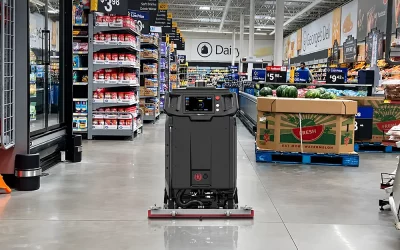
Robotics and automation Machines handle routine tasks (such as maintaining large floor areas), while people focus on supervision, quality control, and specialized interventions that require precision.
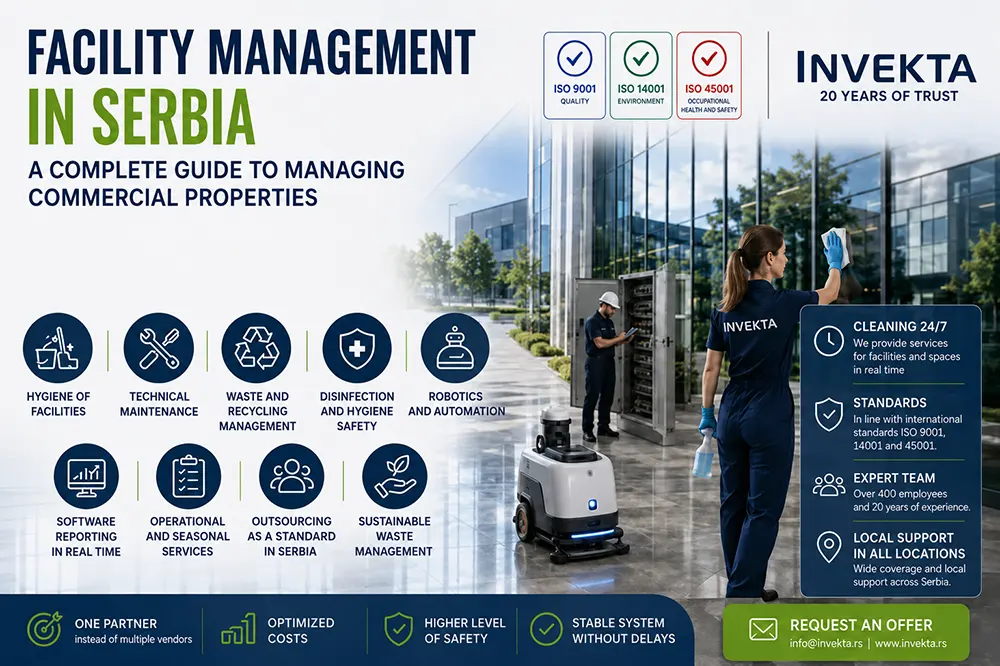
This approach complies with internationally recognized standards. Invekta operates in accordance with three certifications recognized by the Institute for Standardization of Serbia: SRPS ISO 9001 for quality management, SRPS ISO 14001 for environmental management, and SRPS ISO 45001 for occupational health and safety. This means that every process, from planning to execution, follows a proven control system rather than relying solely on internal quality assessments.
How is system performance monitored?
With Invekta, clients receive more than just reports. They gain real-time insight into the status of services across facilities and zones through a digital system. This includes:
- what has been completed
- when it was completed
- where deviations from the plan exist
- what is currently in progress
The goal is not “transparency for the sake of appearances” but control over operational performance without the need for manual inspections and fragmented reports.
Facility management – What makes the difference in professional hygiene maintenance?
A consistent standard, not occasional action, makes the difference in a functional commercial environment. It includes:
- daily hygiene maintenance
- professional cleaning of offices and commercial facilities
- machine floor cleaning and washing
- maintenance of high-touch surfaces and common areas
The goal is not simply cleanliness but a consistently high level of hygiene at all times that directly improves employee productivity and safety. This area represents the core operational pillar of the Invekta maintenance system.
How are robotics and automation transforming facility maintenance?
Robots do not replace people. They take over routine tasks and complete them more efficiently. People focus on control, supervision, and specialized tasks. This approach is becoming increasingly common in modern facility maintenance.
Specifically, this means:
- autonomous floor cleaning
- faster completion of routine tasks
- people working with machine support
- consistent quality with lower operating costs
In addition to robotics in cleaning, modern facility management increasingly relies on Building Management Systems (BMS) and IoT sensors that monitor energy consumption, equipment condition, and indoor environmental conditions in real time.
These systems enable early fault detection, energy optimization, and data-driven decision-making instead of relying on estimates. For companies that follow ESG standards, this type of monitoring is becoming part of their regulatory and reporting obligations, not just an operational advantage.
The goal of technology is not to replace people but to support teams so they can work more accurately, with less improvisation and lower long-term operating costs.
Learn more about its uses and all its benefits in the article AI cleaning robots for commercial facilities.
Facility management – What is technical facility maintenance?
Technical facility maintenance covers heating and cooling systems, electrical and plumbing installations, elevators, fire protection equipment, and the core infrastructure that enables normal operations.
To keep a facility operating without interruptions, it requires regular technical maintenance. This means ensuring that all critical building systems operate continuously and resolving problems before they become serious.
In practice, this also includes daily equipment monitoring, regular inspections, and planned interventions to prevent failures and reduce unexpected downtime. When problems do occur, expert teams and the required service providers resolve them quickly through coordinated action.
Software-based maintenance monitoring is also becoming increasingly common, providing better control, faster response times, and lower long-term costs.
How can you manage waste and resources on time?
- clear on-site waste separation by waste stream: paper, plastic, mixed waste, and specific waste categories
- organized waste collection and cooperation with authorized waste management partners in accordance with legal regulations
- compliance with waste management regulations
- resource consumption optimization and implementation of a zero-waste approach in daily operations
However, the more important aspect is the one that is less visible: reducing waste at its source through better work organization, less material waste, and smarter consumption planning.
Another important segment is recycling and returning materials to use wherever possible because waste is no longer just a cost but also a potential resource. When this system is implemented properly, the results become visible quickly: less clutter, lower costs, and fewer operational issues related to storage and waste collection.
In a broader sense, this is far more than an environmental initiative. It becomes part of resource management that directly improves the efficiency and stability of daily facility operations.
Facility management – How is disinfection planned and carried out in commercial facilities?
In practice, disinfection always follows thorough cleaning and targets the high-touch surfaces that people touch most frequently: door handles, switches, elevator buttons, handrails, work surfaces, equipment, and sanitary areas.
The goal is to systematically reduce the presence of bacteria, viruses, and other pathogens transmitted through everyday contact, not simply to remove visible dirt.
Special attention is given to selecting the appropriate products and methods. Certified biodegradable disinfectants and equipment that ensure even and effective treatment of every surface, including hard-to-reach areas, are used.
The goal remains the same in every situation: to provide a safe working environment that reduces the risk of infection spread and business disruption. Today’s approach to disinfection relies on planned and regular treatment of facilities rather than occasional interventions after problems arise.
What are operational and seasonal services?
This category includes all activities that are not performed continuously but are essential for the uninterrupted operation of a commercial facility throughout different times of the year. These services adapt to the current needs of the facility, its level of use, and external conditions.
This category includes services such as:
- routine and emergency cleaning
- disinfection in emergency situations
- landscaping and green area maintenance
- winter maintenance services
- logistical and technical support during periods of increased workload
The advantage lies in their flexibility. Instead of organizing internal resources for occasional and seasonal tasks, companies can engage these services whenever needed, quickly and efficiently, without placing additional strain on employees or operational systems.
Why is maintenance outsourcing the standard in Serbia?
The professional facility maintenance model enables companies to consolidate all maintenance services under one specialized partner. This reduces the number of suppliers, simplifies communication, and improves control over quality and costs.
Thanks to this centralized approach, companies are increasingly replacing in-house management with an external model that delivers greater efficiency and uninterrupted operations.
Commercial facility management is more than facility maintenance in today’s business environment. It is a system that connects people, processes, and tools. Companies gain a stable maintenance system, optimized costs, and a higher level of operational safety.
Commercial facility management in Serbia – Frequently asked questions (FAQ)
What is commercial facility management and what services does it include?
Commercial facility management is an integrated model that includes hygiene maintenance, technical maintenance, software management, winter maintenance services, green area maintenance, and paper hygiene products. Clients can choose individual services or an integrated package tailored to their needs and budget. For larger companies, this means working with one partner instead of multiple suppliers and benefiting from predictable costs instead of improvised solutions.
Does outsourcing really reduce costs?
In most cases, yes. Savings come from two sources: eliminating the fixed costs of an in-house team and optimizing processes through specialization and economies of scale. However, you can receive a realistic assessment only after your facility has been analyzed.
Which facilities benefit from outsourcing?
It is suitable for office complexes, industrial facilities, logistics centers, healthcare and educational institutions, and retail properties. It is relevant wherever there are large numbers of employees, multiple locations, or complex infrastructure that internal resources cannot reliably manage.
What happens if unexpected situations occur during technical maintenance?
Minor technical issues are resolved immediately on site. In the event of major emergencies, such as burst water or sewage pipes or electrical network failures, Invekta contacts the appropriate emergency services on behalf of the client and coordinates the entire process to restore full functionality as quickly as possible.
Can I arrange integrated services with Invekta for multiple business locations at once?
Yes, integrated services can be arranged for multiple business locations simultaneously, according to the client’s needs and budget. Combining multiple services increases efficiency, reduces unnecessary expenses, and delivers significant annual savings. Thanks to its human, technical, and technological resources, Invekta successfully meets the requirements of clients who operate multiple commercial facilities across Serbia.
What does the transition to an outsourcing model look like?
The transition begins with an assessment of the facility and its current maintenance status. Based on this assessment, a service program, schedule, and budget are defined. Invekta gradually assumes operational responsibility without disrupting ongoing business processes.
Request a free assessment of your facility. Wherever you are in Serbia, Invekta is here for you.
About the author:
Jasna Drenovac – Copywriter and SEO Content Strategist – Content Creation Specialist. With a focus on facility management and hygiene maintenance services, Jasna develops blogs, pillar content, and SEO content. Her work is based on a combination of many years of writing and editing experience and modern SEO standards.
The expert articles published on this blog are the result of research, analytical processing, and editorial work.



0 Comments