

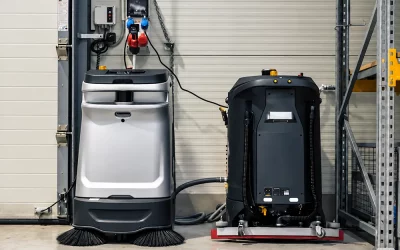
In modern facility management, one question is coming up more and more often in conversations with facility managers: when should you introduce robots, and how can you do it without disrupting operations? The question is no longer whether the technology is mature. Commercial cleaning robots operate in supermarkets, hospitals, warehouses, hotels, and schools around the world. The real question is how to implement them correctly, in the right facility and with the right partner.
Why are cleaning robots becoming the standard in commercial facilities?
The repetitive part of the job-following the same routes, cleaning the same corridors, and maintaining the same standards every day-is naturally suited for automation. While the robot covers these routes, the team can focus on disinfecting high-touch surfaces, handling unexpected situations, and cleaning areas that require human judgment.
Pressure on facility management teams is increasing from several directions at the same time. The areas that require maintenance are becoming larger, cleanliness standards are becoming higher, and the availability of qualified workers for routine tasks is becoming lower. Maintaining large floor areas manually every day, across multiple shifts, while delivering consistent quality, is becoming increasingly difficult to achieve with human teams alone.
Predictability is another factor accelerating adoption. A robot that follows a predefined route, operates at a scheduled time, and delivers measurable results can easily become part of the operational plan and be presented to the client as part of a standardized system.
How does an autonomous cleaning robot actually work?
Before a robot starts cleaning, it must learn the environment. During the initial setup, it uses LiDAR sensors and cameras to build a digital map of the facility, including walls, columns, shelves, partitions, and restricted areas. This map becomes the foundation for all future cleaning routes.
While operating, the robot continuously determines its position on that map and compares what its sensors detect in real time with the recorded environment. Route planning determines how it covers the assigned area: minimal overlap, the optimal cleaning sequence, and avoidance of dead ends.
The robot handles obstacles that were not on the original map in real time. It slows down, goes around them, or waits, depending on the situation. This capability distinguishes it from automatic machines that simply follow a line on the floor.
Commercial cleaning robots – Which facilities are cleaning robots best suited for?
All facilities where cleaning robots deliver the greatest value share the same characteristics: large floor areas, predictable routes, and a high cleaning frequency. These include warehouses, industrial facilities, supermarkets, shopping malls, hospitals, hotels, and parking garages-places with heavy daily foot traffic.
- Warehouses, logistics centers, and industrial facilities are the natural environment for industrial sweeping robots.
- Retail stores and supermarkets use them to clean aisles and parking garages before opening or during the night.
- Hospitals, schools, and nursing homes require documented consistency in cleaning standards as part of their hygiene protocols.
- Hotels and commercial complexes deploy them in long corridors and shared areas during nighttime hours.
What are the specific benefits of robotic cleaning for commercial facilities?
Robotic cleaning delivers five measurable advantages that manual processes cannot achieve: consistency, efficiency, lower operating costs, digital monitoring, and better allocation of human resources.
- Consistent quality without performance decline: robots do not take breaks or get tired.
- Higher efficiency on predefined cleaning routes, guided by AI, sensors, and obstacle detection. They do not miss hard-to-reach areas and always clean with the same level of force, which is significantly greater than human effort.
- Lower operating costs: no overtime, no night-shift premiums, and no staff turnover issues.
- Digital monitoring: every cleaning task is recorded in real time, including coverage, duration, and cleaning zone, without manual reporting.
- Better allocation of human resources: staff can shift from routine floor scrubbing to disinfecting and detailed cleaning of high-touch surfaces.
Facility type |
Main challenge |
What the robot solves |
| Warehouses and logistics centers | Dust, packaging debris, and vehicle dirt across large areas that cannot be cleaned efficiently by hand | Autonomous sweeping and scrubbing along fixed routes during shifts or at night, without requiring an operator |
| Industrial facilities and manufacturing plants | Continuous production of dust and industrial waste combined with strict safety requirements before every cleaning cycle | Systematic cleaning aligned with the work schedule while complying with safety zones |
| Supermarkets and retail stores | Heavy daily foot traffic that prevents cleaning during business hours, while manual nighttime cleaning is expensive | Nighttime or pre-opening cleaning routes that maintain cleaning standards without additional overtime costs |
| Shopping malls and commercial complexes | Long corridors and shared areas that require cleaning several times a day | Flexible robot deployment by zone based on traffic levels throughout the day |
| Hospitals and healthcare facilities | Documented cleaning consistency as part of hygiene protocols | Measurable data on cleaning coverage and frequency by zone, available in real time |
| Schools and educational institutions | Heavy daytime use of the premises, making cleaning possible only outside teaching hours | Nighttime or weekend cleaning based on an automated schedule without supervision |
| Hotels and hospitality facilities | Long corridors and shared areas that require high cleanliness standards guests notice immediately | Nighttime routes that maintain cleaning standards without disturbing guests or requiring additional staff |
| Parking garages and transportation hubs | Dust and vehicle dirt on surfaces that rarely receive thorough cleaning | Regular autonomous routes that prevent dirt buildup and reduce the need for deep cleaning |
Consistency is an advantage that many people underestimate: a robot that follows a predefined route never skips areas because it is tired and never changes its pace depending on the shift.
Data visibility is another benefit that managers often do not expect. Every robot records what was cleaned, when, and where. At any time, management has complete visibility into area coverage and can provide clients with measurable proof of service quality.
Worker safety also improves because the robot takes over long periods of manual floor scrubbing and pushing heavy cleaning machines, activities that contribute to physical injuries and fatigue.
Environmental efficiency comes from precision. Robots regulate water and chemical consumption according to actual conditions, reducing waste compared to manual cleaning processes.
Commercial cleaning robots – Do robots replace people or change the way they work?
The structure of the job is changing, and that will change workforce requirements. Repetitive tasks such as daily scrubbing of long corridors, nighttime sweeping of warehouse aisles, and parking garage cleaning are transferred to the robot. People continue to perform tasks that require judgment and flexibility, including disinfecting high-touch surfaces, cleaning restrooms, responding to spills, and preparing spaces for events.
Organizations that introduce robots reallocate their workforce. Employees who previously spent hours covering routine cleaning routes now focus on supervision, quality control, and tasks that directly influence the experience of people using the facility.
What does introducing robots into an existing cleaning system look like?
A successful implementation process always starts with analysis, not equipment. Before a robot enters a facility, it must be clear which areas require daily cleaning, which are cleaned occasionally, where foot traffic is highest, and when the facility is at its quietest. Based on this information, cleaning routes and schedules are defined.
The next step is calibration. The robot moves through the facility, the map is adjusted to real-world conditions, the routes are finalized, and areas the robot cannot cover are integrated into the manual part of the cleaning process. Team training follows. Employees learn how to start a mission, respond to alarms, and perform basic system checks. The process is not complicated, but it must be systematic.
After the first few weeks of operation, optimization begins. System data reveals where deviations occurred and how schedules should be adjusted. This is a continuous process, not a one-time setup.
Invekta carries out all of these phases in collaboration with the Cenobots system, which provides software support, mapping, and real-time execution monitoring.
How do you choose the right partner for cleaning automation?
The difference between a good and a poor choice becomes clear even before the robot enters the facility. A reliable partner visits the site, analyzes the environment, and only then recommends the appropriate configuration. They monitor performance after implementation and adjust the system whenever operating conditions change.
Integration with existing operational processes is essential. A robot that operates in isolation, without connecting to the rest of the system, delivers limited value. The Cenobots platform, which Invekta uses as its technology partner, provides real-time software monitoring, reporting, and fleet management.
Read more in the article AI cleaning robots for commercial facilities.
Commercial cleaning robots – Frequently asked questions (FAQ)
Can cleaning robots operate in facilities with a large number of people?
Modern autonomous robots use LiDAR sensors and cameras to detect obstacles in real time. They slow down, move around obstacles, or wait when they detect a person or an object. For maximum efficiency, operation during periods of lower foot traffic is recommended.
How long does it take to introduce a robot into a new facility?
A pilot program in a single facility typically lasts four to eight weeks. During this period, the map is created, routes are defined, the team is trained, and schedules are optimized. After that, implementation in similar facilities is significantly faster.
What happens when a robot encounters an unexpected obstacle?
The robot slows down and attempts to move around the obstacle. If that is not possible, it pauses the mission and sends a notification to the operator through the application. The mission resumes once the path is clear or after the operator intervenes.
Can cleaning robots clean all types of flooring?
Different models are optimized for different floor surfaces, including concrete, epoxy, tile, vinyl, and carpet. For facilities with mixed flooring, Invekta recommends a combination of models tailored to each zone so that every surface type is cleaned with the appropriate system.
How is robot efficiency measured after implementation?
The software system records zone coverage, operating time, the number of missions, and any deviations. This data is used to optimize schedules or to provide clients with measurable proof of service quality.
Cleaning automation begins with analyzing the facility, not selecting the robot model.
Contact Invekta for a free assessment of your facility and find out which automation system best suits your needs.
O autoru:
Jasna Drenovac – Copywriter and SEO Content Strategist – Content Creation Specialist. With a focus on facility management and hygiene maintenance services, Jasna develops blog articles, hub content, and SEO content. Her work is based on a combination of many years of writing and editing experience and modern SEO standards.
The professional articles on this blog are the result of research, analytical processing, and editorial work.

0 Comments