

Healthcare hygiene – Before we go into details, it is useful to have a quick overview of the content of this text.
- Zero tolerance for errors
- Standards and international guidelines
- Classification of risk zones in hospitals
- Specific working methods in healthcare facilities
As explained in our Complete guide to maintaining hygiene in commercial spaces, healthcare institutions represent the most demanding level of operational hygiene.
Healthcare hygiene – Zero tolerance for errors
In healthcare institutions, hygiene has a completely different significance than in any other working environment. In hospitals, clinics, and laboratories, cleanliness is not a matter of aesthetics, but a fundamental element of patient safety.
Intrahospital infections represent a serious global issue. According to data from the World Health Organization, a large percentage of infections occur precisely during stays in healthcare institutions. Therefore, proper hygiene maintenance represents one of the most important preventive measures.
In this environment, we are not talking only about cleaning spaces. We are talking about disinfection, sterilization, and controlled contamination management.
Every surface can be a potential source of bacterial transmission. Shared spaces, corridors, door handles, hospital beds, medical equipment, and floors are in constant contact with patients and medical staff.
That is why maintaining hygiene in healthcare institutions must be organized through precise protocols that minimize the risk of pathogen spread.
Healthcare hygiene – Standards and international guidelines
In the healthcare sector, we do not leave hygiene to improvisation. Clearly defined international standards and guidelines determine how we maintain medical spaces.
One of the key authorities in this field is CDC – Centers for Disease Control and Prevention. This institution publishes detailed guidelines on healthcare environment hygiene and surface disinfection methods.
Additional information about these guidelines can be found on the official website:
https://www.cdc.gov
CDC recommendations include proper surface cleaning, contamination control, and disinfection of spaces where patients stay.
In Europe, standards known as HTM – Health Technical Memoranda are also frequently applied. These documents define the management of medical waste, surface decontamination, and safe handling of equipment.
More details about these guidelines.
The third global authority is WHO – World Health Organization. Their protocols for hand hygiene and infection prevention form the basis of many hospital procedures worldwide.
More about these recommendations can be found at:
https://www.who.int
Together, these institutions form a framework that helps healthcare institutions maintain the highest level of hygiene.
Classification of risk zones in hospitals
Professional hygiene maintenance in healthcare facilities begins with proper space classification.
Hospitals are usually divided into three risk zones.
The first category is high-risk zones.
This group includes operating rooms, intensive care units, and isolation rooms. In these areas, standards are the strictest because patients have weakened immune systems, and medical procedures increase the risk of infections.
These zones require sterile conditions and the highest level of disinfection.
The second category is moderate-risk zones.
These include patient rooms, laboratories, and waiting areas. In these spaces, there is constant circulation of patients and medical staff, so regular and thorough hygiene maintenance is necessary.
The third category is low-risk zones.
These include administrative areas, corridors, and reception areas. Although the risk of infection is lower, hygiene must remain at a high level because these spaces connect different parts of the hospital.
Such classification allows resources and working methods to be adapted to the actual level of risk.
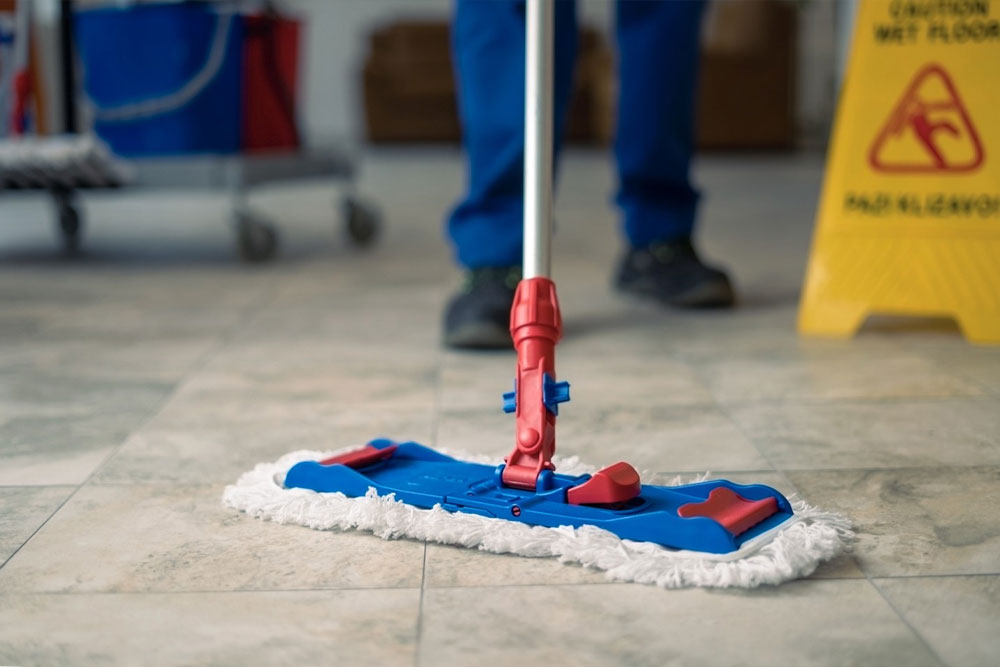
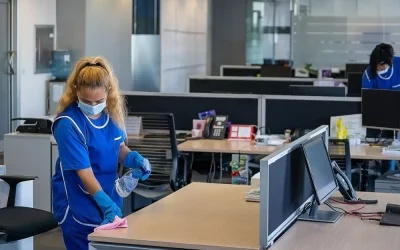
Photo: Invekta Group d.o.o.
Specific working methods in healthcare institutions
Maintaining hygiene in hospitals requires precise procedures developed specifically for the medical environment.
One of the key elements is the use of biocidal products. These are disinfectants that are registered and tested against specific hospital pathogens.
These agents must be effective against bacteria, viruses, and fungi that commonly occur in healthcare institutions.
Another important method is the system known as color coding or equipment labeling by colors.
This system implies that different cloths, mops, and equipment are used for different zones. For example:
red equipment is used for toilets
yellow equipment for patient rooms
blue equipment for corridors and administrative areas
a white glove or white cloth is a control cloth.
| White cloth or mop | Control cloth. Used to check the completed work |
| Red cloth and mop | Dirtiest areas (around toilet bowls, drains, floors) |
| Blue cloth or mop | Work surfaces |
| Green cloth or mop | For kitchens and kitchen work surfaces |
| Yellow cloth or mop | Mirrors in general, and/or in toilets and walls |
This approach prevents cross-contamination between different parts of the facility.
The third key element is staff training.
Working in healthcare institutions requires specially trained workers who understand disinfection protocols, handling of biocidal agents, and proper waste management.
Therefore, maintaining hygiene in hospitals cannot be performed by just anyone. Staff must undergo specialized training to understand the risks and responsibly apply prescribed procedures.
Example of how we helped a private hospital in Belgrade achieve the desired level of hygiene?
First, we trained staff and enabled them to understand the standards and expectations.
We filled out training records and upgraded their knowledge with every day spent on the job.
The hygiene maintenance staff was well organized and assigned by zones with clearly defined tasks.
We introduced professional hygiene maintenance equipment that the staff used in their work.
And we used special bags for collecting medical waste (infectious waste) to prevent contamination.
We polished floors using high-speed machines with a rotational speed of over 2000 rpm so that the floors would achieve a high gloss and be easier to clean and maintain.
The results of this work were more than positive.
In healthcare institutions, hygiene is much more than maintaining a tidy space.
It is a key part of a system that protects patients, medical staff, and the quality of healthcare services.
The application of international standards, proper classification of risk zones, and specialized working methods enable healthcare facilities to operate in a safe and controlled environment.
In this sector, every procedure has one goal.
Prevention of infections and protection of life.
Healthcare hygiene – Frequently asked questions (FAQ)
- What does the level of disinfection in high-risk zones imply? In high-risk zones, such as operating rooms, we apply a level of disinfection that destroys all vegetative forms of microorganisms. We use only certified broad-spectrum biocidal agents and strictly follow the required surface contact time to achieve sterile conditions.
- How does the “Color Coding” system prevent the spread of infections in hospitals? The color coding system (red, yellow, blue) visually prevents staff from using the same cloth or mop in both a toilet and a patient room. This approach eliminates the risk of cross-contamination, one of the most common causes of intrahospital infection spread.
- Do your staff have certificates for working with infectious waste? Yes. Our staff undergo specialized training for handling hazardous and infectious waste in accordance with national regulations and HTM 07-01 standards. This includes proper labeling, use of prescribed packaging, and safe storage until final disposal.
- Why is polishing floors with high-speed machines important for hygiene? In addition to high gloss, machines with over 2000 rpm close micropores on floor surfaces. A floor treated this way becomes smooth, preventing bacteria from remaining and making maintenance and disinfection more efficient.
- How is the quality of maintenance controlled in healthcare facilities? We carry out control through regular visual inspections, checklists, and, if necessary, microbiological surface sampling (swabs). Our operations director performs periodic audits to ensure we fully comply with all CDC and WHO protocols.
If you manage a healthcare institution and want a reliable hygiene maintenance system that follows international standards, contact us for a facility assessment. Our team applies protocols that ensure a stable level of disinfection and safety in medical spaces.
About the author:
Biljana Šapić– Operations Director – Specialist in the implementation of hygiene standards and process optimization in business system maintenance. With a focus on operational excellence, Biljana manages teams that apply ISO and HACCP protocols in the most demanding working environments – from premium office spaces to production facilities. Her work is based on the principle of “invisible efficiency” – creating impeccable order that enables clients to focus seamlessly on their growth.
Professional texts on this blog are the result of a combination of many years of field experience and advanced analytical data processing, with final authorization by the author.

0 Comments