

Complete guide to maintaining hygiene in commercial spaces – In the modern business world, there is one detail that people notice before the presentation, before the meeting, and before the product itself.
Space.
The way the work environment looks says a lot about the company. A tidy and clean space signals professionalism, organization, and trust. A messy space sends a completely different message.
Therefore, maintaining hygiene in commercial spaces is no longer just a logistical activity. It has become part of the business infrastructure, equally important as IT support or facility security.
Companies that understand this have a more stable work environment, more satisfied employees, and a better impression among clients.
This complete guide to maintaining hygiene in commercial spaces explains how professional hygiene maintenance works, why it is important, and how companies can achieve a consistent standard of cleanliness in every facility.
Here you will read:
- Why maintaining hygiene in commercial spaces is important
- What is the difference between regular cleaning and professional hygiene maintenance
- Office hygiene maintenance
- Hygiene in production facilities
- Hygiene standards in healthcare institutions
- How much maintaining hygiene in commercial spaces costs
- Outsourcing hygiene maintenance
- The future of hygiene in the workplace
- How to choose a company for maintaining hygiene in commercial facilities?
- FAQ
Why maintaining hygiene in commercial spaces is important
Maintaining hygiene in commercial spaces is important because it provides employees with a clean and organized workspace, greater focus, and mental clarity. People concentrate more easily and enter their work rhythm faster. This results in higher productivity, fewer sick leaves, greater enthusiasm, and employee motivation. Maintaining hygiene in commercial spaces creates a better perception among clients about you and your brand, as it implies that the business itself is organized. The opposite is also true.
In addition, it enhances the company’s brand image. Adequate hygiene maintenance encourages employees to feel comfortable within the company.
A large number of people use the workspace daily. Every contact with surfaces leaves a trace. Door handles, desks, elevator buttons, handrails, and shared areas become places where bacteria spread most easily.
If hygiene maintenance is not properly organized, the risk increases rapidly.
Poor hygiene can lead to:
- a higher number of employee sick leaves
- faster wear and tear of surfaces and equipment
- a negative impression on clients
- increased operational costs
On the other hand, professional maintenance of hygiene in commercial facilities creates a stable and safe working environment.
A clean space helps employees work with focus and leaves a strong professional impression on everyone who enters the facility.
What is the difference between regular cleaning and professional hygiene maintenance?
Regular cleaning involves certain activities such as mopping floors, cleaning toilets and/or emptying trash bins, while professional hygiene maintenance leaves nothing to chance. Professional maintenance should encompass the entire specification that must meet standards defining cleaning procedures, contamination control, employee safety, and service quality. It includes planned procedures, defined cleaning intervals, quality control, and the selection of appropriate agents for each type of surface.
Key standards in hygiene:
- ISO 9001 – a quality management standard. Its application in hygiene means that the company has clearly defined work procedures, service quality control, documentation, and continuous process improvement.
- ISO 14001 – an environmental management standard. In practice, it means the use of environmentally friendly cleaning agents and responsible waste management.
- ISO 45001 – an occupational health and safety standard. Important for workers who handle chemicals, machinery, and work on slippery surfaces.
HACCP (Hazard Analysis and Critical Control Points) A standard used in restaurants, hotels, food factories, and kitchens. It defines hygiene of premises, equipment, employees’ hands, and the prevention of food contamination.
- ISO 22000 An advanced food safety standard that includes HACCP principles and additional process controls.
- EN 13549 – a European standard for cleaning service quality. Defines how cleaning quality is measured in facilities.
- INSTA 800 – a Scandinavian standard for cleaning quality control. Uses visual inspection and statistical methods to assess cleanliness.
- HTM 01 / HTM 07 – standards for hygiene in healthcare institutions.
- CDC Guidelines for Environmental Cleaning – guidelines for hospitals and healthcare institutions.
- EU Biocidal Products Regulation (BPR) – regulates disinfectants.
- REACH regulation – control of chemicals used in Europe.
National sanitary standards:
Each country has its own regulations regarding:
- sanitary conditions of premises
- disinfection, disinsection, and deratization (DDD)
- safe storage of chemicals
- employee hygiene
In Serbia, this is regulated by sanitary regulations of the Ministry of Health and sanitary inspection.
Many companies believe that it is sufficient to clean the space occasionally. However, as mentioned, there is a significant difference between basic cleaning and professional hygiene maintenance.
Professional hygiene maintenance implies much more.
In a professional model, every space has a clearly defined maintenance regime. This means that hygiene does not depend on the current situation, but on a predefined work plan.
This approach ensures a consistent standard of cleanliness at all times.
Specifics of maintenance by facility type
Office hygiene maintenance
Office spaces have specific challenges. A large number of employees use the same space throughout the day, and shared surfaces are constantly in contact with hands.
The most frequently touched surfaces in offices are:
- desks
- keyboards and mice
- light switches
- door handles and handrails
- kitchen areas
- door handles
Without a proper cleaning regime, these surfaces can become a source of bacterial spread.
Professional office cleaning includes regular maintenance of all contact points, disinfection of shared areas, and maintenance of floor surfaces.
The result is a healthier working environment and greater comfort for employees.
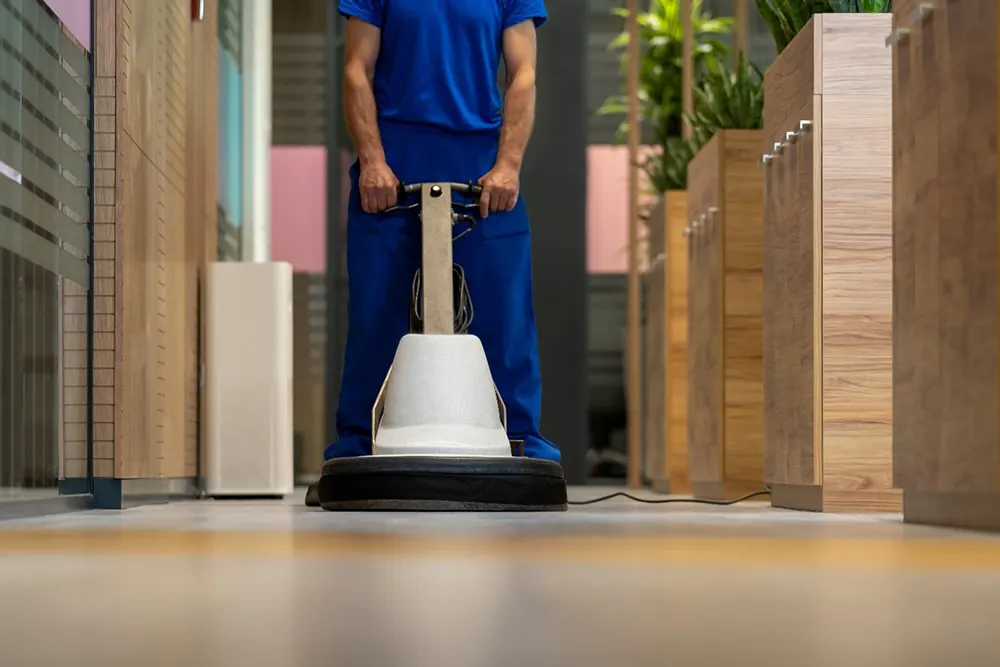
Photo: Invekta, complete guide to maintaining hygiene in commercial spaces
Hygiene in production facilities
Production facilities require an even higher level of discipline in hygiene maintenance.
In industrial facilities, cleanliness is not important only for the appearance of the space. It is part of production quality control.
Contamination in a production environment can cause serious problems, especially in the food, pharmaceutical, and technological industries.
Therefore, maintaining hygiene in production facilities must include:
- control of industrial dust
- proper cleaning of production zones
- maintenance of wear-resistant floor surfaces
- disinfection of critical zones
A professional approach ensures that production processes function in a controlled and safe environment.
“Learn more about specific standards and cleaning methods in industrial facilities”
Hygiene standards in healthcare institutions
In healthcare facilities, hygiene plays an even greater role. It directly affects the safety of patients and medical staff.
Hospitals and clinics have strictly defined hygiene maintenance protocols that include surface disinfection, proper waste handling, and regular cleaning of all medical areas.
Maintaining hygiene in hospitals requires special attention, as even the smallest mistake can increase the risk of infections.
Therefore, it is important that this work is performed by trained professionals who are familiar with standards in the healthcare sector.
Read more about this topic in the article “Healthcare hygiene”.
How much does maintaining hygiene in commercial spaces cost
The cost of maintaining hygiene in commercial spaces depends on several factors.
The most important are:
- facility size
- frequency of maintenance
- type of space
- industrial requirements
- specific client needs
For example, office hygiene maintenance has different requirements than maintenance of production facilities or medical facilities.
A professional assessment of the space allows the creation of a work plan that ensures an optimal balance between costs and service quality.
If you would like us to help you redefine hygiene maintenance standards in your company, request a free assessment.
Complete guide to maintaining hygiene in commercial spaces – Outsourcing hygiene maintenance
More and more companies are opting for hygiene outsourcing instead of employing their own staff.
The reason is simple. Professional companies have the experience, equipment, and organization that enable consistent service quality.
The advantages of outsourcing include:
- cost control
- professionally trained staff
- a consistent hygiene standard
- flexibility in work organization
This model allows companies to focus on their core business while leaving hygiene to experts.
Complete guide to maintaining hygiene in commercial spaces – The future of hygiene in the workplace
The professional cleaning industry is rapidly evolving. Modern approaches include digital activity planning, standardized work protocols, and quality control.
Companies are increasingly viewing hygiene as part of the overall working environment.
This means that hygiene maintenance is becoming an important factor in employee productivity, facility safety, and company reputation.
The future of this industry lies in precise planning, sustainable methods, and a consistent standard of quality.
How to choose a company for maintaining hygiene in commercial facilities?
Choosing a hygiene maintenance partner is an important business decision. When making a selection, attention should be paid to several factors:
- experience working with commercial facilities
- how long they have been on the market
- clearly defined work procedures
- service quality control
- flexibility in organizing maintenance
- whether they use software solutions in daily operations
- service transparency
- possession of certifications
A professional hygiene maintenance company understands the needs of different industries and can adapt its approach to each facility.
Maintaining hygiene in commercial spaces today is much more than cleaning.
It is part of a business strategy that affects employee health, company reputation, and the quality of the working environment.
Companies that invest in professional hygiene maintenance gain a consistent standard of cleanliness, predictable costs, and the assurance that their business space always leaves the right impression.
Because a top-tier working environment does not happen by chance.
It is planned.
Complete guide to maintaining hygiene in commercial spaces – Frequently asked questions (FAQ)
- What is the key difference between regular cleaning and professional hygiene maintenance? Regular cleaning is focused on visual tidiness (dusting, emptying bins), while professional maintenance follows strict ISO standards and predefined protocols. It involves contamination control, the use of certified agents, and regular quality checks to ensure a consistent standard regardless of current circumstances.
- How often should professional cleaning of commercial space be performed? The frequency depends on the type of facility and the number of people using it. For high-traffic offices and retail spaces, daily maintenance of contact surfaces is recommended. For production facilities and specific industries, the work plan is created based on the level of contamination and hygiene risks, which may involve multiple shifts.
- What does outsourcing hygiene maintenance in commercial spaces include? Outsourcing involves transferring full responsibility for cleanliness to an external professional company. This includes providing trained staff, professional machines and chemical agents, as well as managing consumable supplies (paper towels, soaps). In this way, the company reduces operational costs and focuses on its core business.
- Does professional hygiene maintenance reduce employee sick leave? Yes. Through proper disinfection of “critical points” such as door handles, keyboards, switches, and shared spaces, the spread of viruses and bacteria is significantly reduced. A healthier work environment directly contributes to lower absenteeism and higher team productivity.
- What are the most important standards a hygiene maintenance company should have? The most important international standards are ISO 9001 (quality management), ISO 14001 (environmental protection), and ISO 45001 (occupational safety). For specific industries such as food production, the application of HACCP principles is essential, while strict HTM and CDC guidelines are followed in medical institutions.
Request a free assessment of your facility. Regardless of where you are in Serbia, do not worry, Invekta covers the entire country.
About the author:
Biljana Šapić – Operations director – Specialist in the implementation of hygiene standards and process optimization in business system maintenance. With a focus on operational excellence. Biljana manages teams that implement ISO and HACCP protocols in the most demanding work environments – from premium office spaces to production facilities. Her work is based on the principle of “invisible efficiency” – creating impeccable order that enables clients to focus seamlessly on their growth.
Professional articles on this blog are the result of a combination of many years of field experience and advanced analytical data processing, with final author authorization.



0 Comments