

Can a cleaning robot work at night unattended? Yes, the robot can autonomously perform a preset task at night, without a person continuously accompanying it throughout the facility. It uses sensors (LiDAR, cameras) to follow the map and route, recognizes obstacles, and returns to the station when the job is completed or when the battery is low. However, the required level of human supervision still depends on the type of facility and the system configuration.
For commercial facilities, commercial cleaning robots can take over repetitive floor-cleaning tasks outside regular working hours, while the schedule, work zones, and required level of supervision are adjusted to the specific facility.
Does the robot need a person to physically walk behind it?
No. Once the route, schedule, and accessible zones are set, the robot performs the cleaning cycle independently, with minimal human intervention. Instead of physically following it, staff can remotely monitor the status, location, battery level, and task progress through the management system. So they do not need to remain physically present next to the robot throughout the entire cycle.
This does not mean staff lose their role. The robot takes over repetitive floor cleaning, while staff remain responsible for preparing the space, carrying out periodic checks, maintaining the robot, and handling tasks the machine does not perform, from emptying bins to detailed cleaning of surfaces above floor level.
How does the robot work in facilities with a night shift?
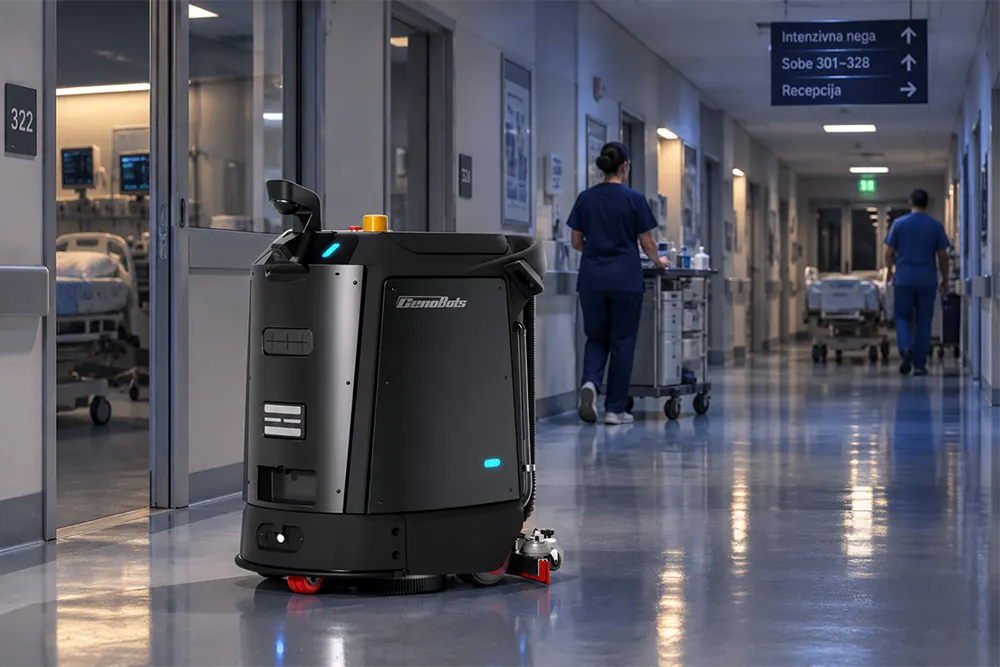
In a hospital, factory, or logistics center, a robot can work alongside employees, while autonomous navigation allows it to adapt to people and obstacles in the work zone. Staff intervene only when they need to resolve a situation the robot cannot overcome on its own.
For example, in a hospital, a more compact robot such as the L3 model can scrub corridors while medical staff continue their work. If a bed, trolley, or person appears in its path, the navigation system reacts to the change in the environment. In a factory or logistics center, the same principle allows the robot to clean dust, loose debris, or large hard floor surfaces while other activities continue in permitted zones.
When a robot operates autonomously in a space where employees move around at the same time, it is important to include its operating mode, routes, and potential interactions with people in the risk assessment and work organization. These issues are also addressed by EU-OSHA in its guidelines on advanced robotics and the automation of work tasks.
How does the robot work in facilities that are completely empty at night, such as offices?
In a closed office, the robot receives a pre-scheduled task and autonomously cleans mapped and accessible zones while employees are away. For this operating mode, the routes, schedule, accessible rooms, and charging method are defined in advance so the cycle can be completed with minimal staff intervention.
In practice, this means employees do not need to “leave someone with the robot” before leaving. It works in open parts of rooms, corridors, and other mapped zones that are physically accessible to it. The limitation remains the same as in facilities with a night shift: the robot cannot overcome locked doors or access unmapped rooms on its own, so the organization of the space must align with the cleaning plan.
How does the organization of night work differ by type of facility?
The organization depends on whether the facility is empty at night or whether people are still inside it. In offices, the robot cleans after the staff leave, while in hospitals, hotels, factories, and logistics centers, its routes are coordinated with people, equipment, and activities that continue throughout the night.
| Type of facility | How the robot works at night | What the robot does | What remains for staff |
| Offices | Cleaning is scheduled after employees leave | Washing and drying hard floors, vacuuming and sweeping work areas | Restrooms, desks, bins, stairs, detailed cleaning |
| Shopping centers | Main cleaning is organized after closing time | Washing large open areas, removing dry and localized debris | Restrooms, stairs, emptying bins, hard-to-reach areas |
| Hospitals | The robot works in defined zones while patients and staff are present | Washing and drying corridors and other hard floor surfaces | High-touch surfaces, restrooms, detailed cleaning, and zones inaccessible to the robot |
| Hotels | Common areas are cleaned during quieter periods, with adjustments made for guests | Washing hard floors, vacuuming, and targeted cleaning | Rooms, bathrooms, stairs, furniture, bins |
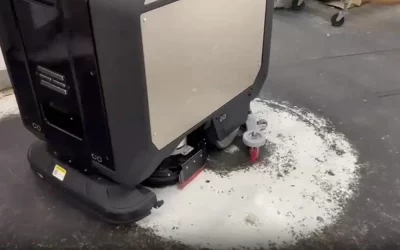
| Factories | The robot works during the night shift, coordinated with people and machines | Dry sweeping of dust and debris, washing large hard surfaces | Detailed cleaning around equipment, hard-to-reach zones |
| Logistics centers and warehouses | The robot works alongside the night shift, with routes planned outside busy periods | Sweeping large areas, washing hard floors, removing dry debris | Inaccessible zones, larger obstacles, detailed maintenance |
Can a cleaning robot work at night unattended?- FAQ
Can the robot clean all night without interruption?
Not necessarily. Autonomous operation is not the same as continuous operation without a break. The duration of the cycle depends on the model, battery, task, and the size of the area being cleaned. When the battery level drops, the robot returns to a compatible charging station and, depending on the system configuration, resumes work after recharging.
How does the robot clean a multi-story building?
Moving between floors depends on the facility infrastructure and the system configuration. If the robot is not connected to a system that enables autonomous elevator use, staff move it to another floor, where it continues working in a previously mapped and configured zone. In mixed commercial facilities with multiple types of spaces on each floor, a model such as the L4 is often used, adapted to medium and larger areas with mixed pedestrian traffic.
Who checks in the morning whether the cleaning has been completed?
The responsible person checks the status and available data on the completed task through the management system. Digital monitoring ensures that the result does not rely only on the assumption that the robot followed the planned route during the night. But on actual insight into which zones were cleaned and whether the cycle was fully completed.
When the lights go out, cleaning does not have to stop.
A properly configured robot can take over the floors during the night, while the team returns to a space ready for a new working day.
See what night cleaning would look like in your facility.
About the author:
Milja Tonić – SEO Content Strategist & Copywriter
Milja Tonić is an SEO Content Strategist and Copywriter, specializing in creating expert content in the fields of facility management, professional maintenance of commercial facilities, and cleaning process automation.
Through research, SEO strategy, and editorial writing, she develops content on professional hygiene, facility management. And the use of autonomous cleaning robots in different business environments.

0 Comments