


What is a docking station for an autonomous robot? A docking station for an autonomous robot is a term commonly used for a place that a robot reaches autonomously for charging or other servicing tasks, but with CenoBots models, you need to distinguish between a charging station and a multifunctional workstation. Their functions depend on the model: some only charge the battery, while others also manage water and detergent.
For this reason, simply saying that a robot “has a station” does not provide enough information. For the S5, the manufacturer specifies a Charging Station, while the L3 can use the WS3 Workstation, which automates both charging and servicing of the cleaning system. The L4 offers an optional 4-in-1 Workstation, while for the SP50 and L50, the manufacturer confirms autonomous functions, although publicly available pages do not describe their stations in the same level of detail.
The station represents only one part of a system that needs to match the surface area, floor type, and facility maintenance requirements. Therefore, equipment selection starts by determining which commercial cleaning robots suit the specific operating conditions, after which the required station and additional equipment can be selected.
What is the difference between a charging station and a workstation?
A charging station primarily charges the robot’s battery, while a workstation can combine charging with other servicing processes. For scrubber-dryer models, a suitable workstation can refill clean water, drain dirty water, and replenish detergent, reducing the need for manual intervention between tasks.
This difference becomes particularly important for robots that wash floors. The S5, for example, sweeps and collects debris, so it does not require a water refilling and draining system. The L3 and L4 use water during cleaning, so a workstation can automate several steps that would otherwise require manual servicing of the robot.
What is the WS3 workstation for the L3?
The WS3 Workstation is a multifunctional workstation designed for the L3 model. The manufacturer specifies four automated functions: battery charging, water refilling, dirty water drainage, and detergent refilling. It combines routine servicing tasks between cycles and allows the L3 to continue scheduled cleaning tasks with less staff intervention.
This means that the L3 does not need another station solely for charging when it uses the WS3, because charging is already one of the WS3 functions.
The manufacturer lists the WS3 among the additional equipment for the L3 together with the WT3 mobile water tank. However, these two components do not perform the same function: the WS3 directly services the robot, while the WT3 addresses water availability in certain facilities.
What is the WT3 mobile water tank used for with the L3?
The WT3 is neither a charging station nor a replacement for the WS3. It is a mobile water system designed for L3 configurations in facilities where a fixed water connection is unavailable or impractical. The manufacturer states that the WT3 reduces the system’s dependence on fixed water infrastructure and enables longer cleaning cycles.
What does the 4-in-1 workstation for the L4 do?
The L4 can use an optional 4-in-1 Workstation that combines four servicing functions: automatic battery charging, clean water refilling, wastewater drainage, and detergent refilling. Unlike a conventional station that only charges the robot, this workstation also automates processes involved in preparing the scrubber-dryer robot for the next cleaning cycle.
How does the S5 charge?
The S5 uses a Charging Station for automatic battery charging. When the battery level drops, the robot can autonomously return to the station, charge its battery, and resume its previous task without manual intervention. Because the S5 sweeps and collects debris, it does not require clean and dirty water management functions.
How do the L50 and SP50 charge?
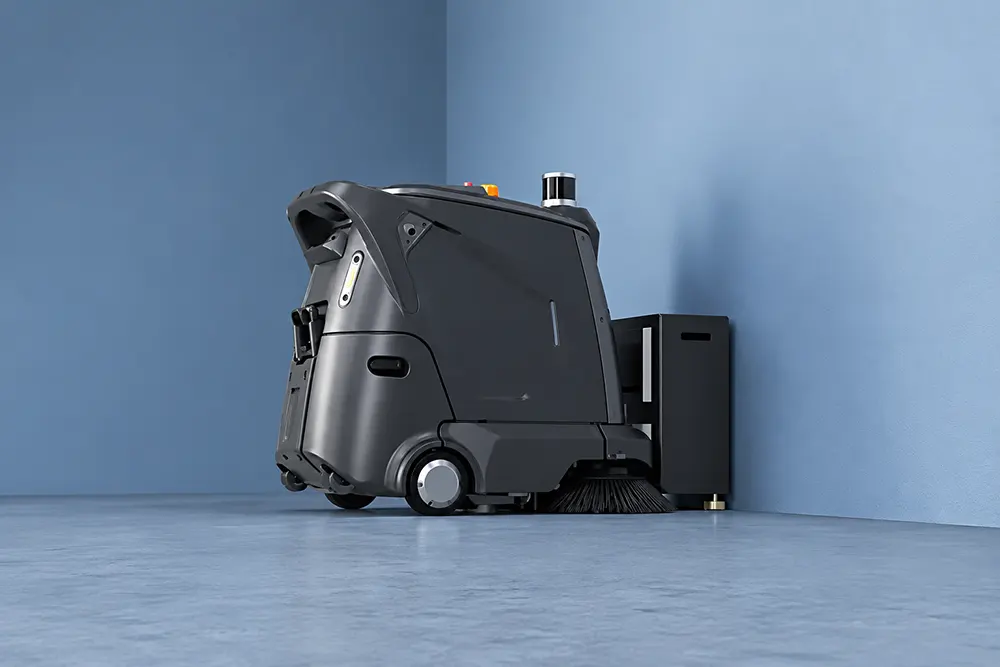
The L50 supports autonomous recharging, while the public product pages for the L50 and SP50 do not present additional charging equipment with the same level of detail as the pages for the S5, L3, and L4. Therefore, you should not specify the name or functions of a particular station for these two models without additional technical documentation.
For the L50, the manufacturer explicitly describes fully autonomous cleaning and states that the robot can navigate, clean, and recharge autonomously. The L50 is a scrubber-dryer with a 55-litre solution tank, but the current product page does not provide enough information to equate the functions of its station with those of the WS3 or the L4 4-in-1 Workstation.
The SP50 differs because it performs vacuuming and sweeping on hard and soft floor surfaces. It does not use a clean and dirty water system like scrubber-dryer models, so it does not require water refilling, water drainage, or detergent refilling functions.
Does a robot need a workstation to operate?
A battery-powered robot needs a charging method, but a multifunctional Workstation does not represent the same basic charging requirement. For compatible models, it automates additional servicing processes alongside battery charging. Whether a facility needs this type of station depends on the model, configuration, and desired level of autonomy.
Which station does each robot model use?
| Model | Solution confirmed by the manufacturer | Function |
| S5 | Charging Station | Automatic return, battery charging, and resumption of the previous task |
| L3 | WS3 Workstation | Battery charging, water refilling, dirty water drainage, and detergent refilling |
| L3 | WT3 Mobile Water Tank | Mobile water capacity when a fixed connection is unsuitable |
| L4 | Optional 4-in-1 Workstation | Charging, clean water refilling, wastewater drainage, and detergent refilling |
| L50 | Autonomous recharging confirmed | The robot can recharge autonomously |
| SP50 | Autonomous docking and charging | The robot docks and charges autonomously |
When does a multifunctional workstation provide the greatest value?
A multifunctional workstation provides the greatest value in facilities with frequent or extended washing cycles, where robot servicing would otherwise require regular staff intervention. By automating these steps, the workstation reduces the need for employees to prepare the robot between tasks, which proves particularly useful when cleaning continues for extended periods or when staff presence remains limited.
What should you check before choosing a robot and station?
Before choosing a robot, check how the specific model charges, which additional equipment it supports, whether water supply and drainage are available, how much space the station requires, and what level of automation the facility actually needs. The broader safety framework for autonomous mobile systems also covers working-zone conditions, as addressed by the ISO 3691-4:2023. standard. A Workstation provides the most value when its additional functions address an actual facility requirement, rather than simply because the robot supports such equipment.
For the L3, you should also consider whether a suitable water connection is available or whether the WT3 would be useful. For the L4, you should assess the value of the optional 4-in-1 automation. With the S5, the focus remains on automatic charging, while for the L50 and SP50, you should confirm the specific charging configuration through technical documentation and the offer prepared for the particular installation.
What is a docking station for an autonomous robot?- FAQ
Does the station need a dedicated location within the facility?
The station requires a pre-planned location that the robot can access and use safely without obstruction. Specific requirements depend on the model and type of station, while workstations that manage water also require suitable infrastructure. Therefore, the station location should follow the technical requirements of the specific installation.
Can one robot perform multiple tasks between two visits to the station?
Yes, but the length of time a robot can operate before returning depends on the model, task, and operating conditions. Battery capacity, surface area, cleaning mode, and, for scrubber-dryer models, the available amount of water can all affect cycle duration. Therefore, you should plan the operating cycle according to the specific facility.
Should you plan the station selection together with the robot selection?
Yes. You should consider the station and required infrastructure when planning the robot implementation. This approach allows you to coordinate the station location, robot access, available connections, and expected operating mode in advance, instead of adapting the space to the requirements of the selected configuration after installation.
Fewer interventions. Greater continuity. Connect the robot and station into a system tailored to your facility.
About the author:
Milja Tonić – SEO Content Strategist & Copywriter
Milja Tonić is an SEO Content Strategist and Copywriter specialising in creating expert content on facility management, professional maintenance of commercial facilities, and cleaning process automation.
Through research, SEO strategy, and original content development, she creates content on professional hygiene, facility management, and the use of autonomous cleaning robots in various commercial environments.

0 Comments