


Can a robot vacuum work without Wi-Fi? A cleaning robot does not have to rely exclusively on the internet to navigate, detect obstacles, and make certain decisions during operation. Modern autonomous models use built-in AI computing platforms, LiDAR, cameras, and other sensors. However, the availability of specific functions without an internet connection depends on the particular model and system configuration.
According to EU-OSHA, the European Agency for Safety and Health at Work, advanced robotics and AI systems in industrial and warehouse facilities are increasingly taking over automation tasks, while EU-level policies and strategies need to keep pace with this development.
For example, the S5 model uses an NVIDIA AI computing platform with 100 TOPS of processing power and a 32-channel 3D LiDAR with a detection range of up to 150 metres. This system enables mapping, safe navigation, and real-time decision-making.
L3 also uses an NVIDIA AI platform and 3D LiDAR for autonomous route planning and obstacle avoidance. In the L4, 3D LiDAR, 3D depth cameras, and contact sensors support navigation.
This shows that the robot itself collects the key data required to perceive its surroundings through onboard equipment. However, the manufacturer does not state that all navigation functions of all models are guaranteed to remain available in a completely offline mode, so this claim should not be generalised.
An internet connection is only one of the technical factors to consider when selecting an autonomous system. Cleaning robots for commercial spaces differ in purpose, operating method, and functionality, so the selection should match the conditions and requirements of the specific facility.
What happens if the internet connection drops during cleaning?
The available specifications do not allow us to determine reliably how every model behaves after a complete loss of internet connection. The robot manufacturer confirms autonomous navigation but does not explicitly state that every task already in progress will continue without internet access in every configuration. Therefore, this capability should be verified for the specific system.
This is an important distinction. The fact that a robot has LiDAR, sensors, and its own computing platform does not by itself prove that the entire system was designed for completely offline operation.
Before deploying a robot in a facility where Wi-Fi is unstable or occasionally unavailable, it is necessary to check what happens to an active task after the connection is interrupted and which functions remain available until the connection is restored.
Which functions may depend on a network connection?
A network connection is particularly important for functions that connect the robot to external devices and services. These may include a mobile application, remote location and status monitoring, receiving notifications, managing certain tasks, and OTA software updates. These functions should be distinguished from the robot’s sensor-based perception and navigation.
For the L4, the manufacturer provides a mobile application that allows the user to track the robot’s movement and location, review operating data, plan routes, and receive notifications about completed tasks.
The L50 and SP50 also have mobile applications, while their specifications also include OTA (Over-the-Air) updates for new functions.
For this reason, losing network access should not be equated with losing all of the robot’s capabilities, but neither should you assume that functions connected to the application and remote access will remain available.
Is Wi-Fi required to monitor the robot through the application?
Remote monitoring of the robot through a mobile application requires appropriate network communication between the system and the user’s device. For certain models, the CenoBots application allows users to track movement and current location, review data, plan routes, and receive notifications, so these capabilities should not be confused with basic autonomous navigation.
For example, with the SP50, the application allows the user to track the robot’s movement, receive information about its operation, plan routes, and receive notifications when cleaning is complete.
The manufacturer lists similar capabilities for the L50 and L4.
In practice, this means that when assessing a facility’s network infrastructure, it is not enough to ask only “can the robot move”. It is also important to determine who needs to monitor the robot, from where, and which information must be available in real time.
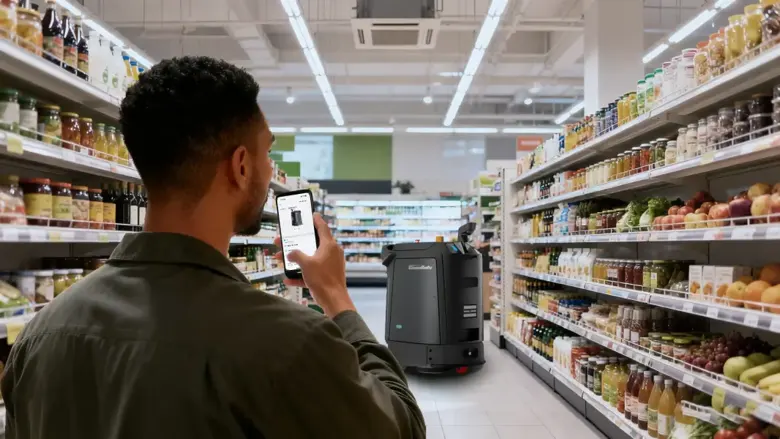
Can a robot detect obstacles without the internet?
Obstacle detection in autonomous models relies on LiDAR, cameras, sensors, and data-processing algorithms that the robot uses while moving. The manufacturer’s specifications confirm this type of onboard perception in several models. However, the manufacturer does not make a general statement that full detection functionality is guaranteed without a network connection in every configuration.
| What to check | Why it matters |
| Continuation of an active task | Check whether the robot continues a cleaning task that has already started after the connection is interrupted |
| Starting a new task | Determine whether a network connection is required to start a new route or task |
| Mobile application | Check which application functions remain available without an internet connection |
| Remote monitoring | Determine whether it is possible to monitor the robot’s status and location when there is no connection |
| Operating data | Check how data is stored and synchronised after the connection is restored |
| Software updates | Determine what type of network connection is required for OTA or other updates |
| Network coverage within the facility | Check Wi-Fi/network coverage in warehouses, underground levels, and other problematic areas |
Can a robot vacuum work without Wi-Fi?- FAQ
Does a robot need internet access during the initial setup?
The specific model, configuration, and activated functions determine the initial setup requirements. The manufacturer’s documentation confirms connected functions for certain models. However, it does not provide a universal rule stating whether every step of the initial setup requires internet access. Therefore, check the network requirements before installation.
Can multiple robots operate in the same facility if the internet connection is unstable?
The manufacturer supports coordination between multiple robots through functions such as TeamClean on compatible models. However, publicly available specifications do not explain how a loss of internet connection affects their coordination. If you plan to use multiple robots, confirm the network requirements for the specific configuration.
Is a stable internet connection a criterion when choosing a cleaning robot?
It can be an important technical criterion if the facility requires remote monitoring, an application, data exchange, or other connected functions. When choosing a robot, you should therefore consider the network infrastructure together with the size of the area, type of flooring, cleaning tasks, and the way staff will operate the robot.
Technology works best when it matches the space. Let’s start with the needs of your facility.
About the author:
Milja Tonić – SEO Content Strategist & Copywriter
Milja Tonić is an SEO Content Strategist and Copywriter specialising in creating expert content in the fields of facility management, professional maintenance of commercial facilities, and automation of cleaning processes.
Through research, SEO strategy, and original content development, she creates content on professional hygiene, facility management, and the use of autonomous cleaning robots in different commercial environments.

0 Comments