


Implementing a cleaning robot in a company takes about ten weeks from the initial consultation to stable operation without constant supervision, through several clearly defined phases.
How much time does a company need to prepare before implementing a cleaning robot?
According to practical experience, the entire process begins about ten weeks before the device physically arrives at the facility. The regional management discusses the scope of work, budget, and expectations.
This phase aligns the key parameters:
- which areas are included in the project
- what the shift schedule looks like
- who is responsible for daily communication with the supplier
Companies that skip this step and proceed directly to ordering the equipment often end up improvising decisions they should have clarified from the very beginning.
What do zone managers do during the preparation phase?
Zone managers identify actual obstacles within the facility, such as:
- narrow passageways
- changing merchandise layouts
- areas with frequent congestion
These are details that senior management rarely has at that level of precision. Zone managers become involved approximately six weeks before the start, and their role also includes preparing on-site staff in advance for the upcoming change, instead of having the machine simply appear in the hallway one day.
What does staff training look like before deployment?
Three weeks before deployment, staff complete training through four modules delivered via the company’s internal learning system.
The first module covers the fundamentals of robotics and addresses common misconceptions employees often bring from social media, such as whether the machine is a humanoid robot.
The following modules explain how the robot and the operator work together and support each other. The final module focuses on the specific machine the team will use, including the interface, cleaning procedures, and maintenance routine.
Only after completing all modules and obtaining certification does the implementation specialist arrive on-site. The robot is handed over to the operator in person, and the field manager also receives training because they continue managing the program after the implementation team leaves.
What happens on the first day of robot deployment?
The first day rarely involves fully autonomous operation without supervision, even on well-prepared projects. The team tests the mapping in a real, occupied environment rather than in an empty demonstration hall. Only then does it become clear how the machine responds to carts, people, and changing obstacles.
A realistic expectation is that someone from the team will remain present during the first route, ready to intervene. Not because the equipment is unreliable, but because every facility has unique characteristics that cannot be identified in advance.
How long does the monitoring period last after deployment?
After the initial deployment, practical experience shows that a twenty-one-day monitoring period is the minimum before the project can be considered stable. During this time, the team monitors missed sections of the route, the actual charging cycle duration compared to the planned schedule, and staff responses to their new responsibilities. Only after these three weeks does it make sense to prepare final time-saving reports or plan expansion into additional areas.
Implementing a cleaning robot in a company – What mistakes do companies make most often?
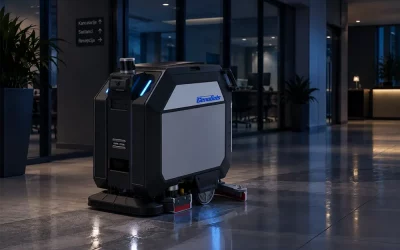
The most common mistake is assuming that autonomous means completely free from human attention. Even with a docking station that handles charging and water refilling, several small recurring tasks remain:
- refilling the cleaning solution
- cleaning the sensors
- emptying the filter
On average, these tasks require about fifteen to twenty minutes of attention per shift. KBS, a major facility management company that deploys hundreds of robots every year, confirms this pattern through its own experience. Some clients initially attempted to manage the robot fleet independently without properly preparing their teams. In the end, they returned to the company and requested that it take over fleet management because their internal teams simply could not dedicate enough time to regular operation and maintenance. A tool is only as effective as the care it receives. The same applies to a robot as it does to a traditional floor mop.
How does implementing a cleaning robot in a company work, a brief overview
The entire process, from the initial consultation to stable operation, takes about ten weeks and moves through clearly defined preparation, training, deployment, and monitoring phases. In practice, using different robot models for different areas rather than relying on a single universal robot for the entire facility delivers better results.
| Step | Duration | Activities |
| 1. Management consultation | 10 weeks before deployment | Discussion of the scope of work, budget, and areas |
| 2. Involving zone managers | 6 weeks before deployment | Identifying obstacles and preparing on-site staff |
| 3. Staff training | 3 weeks before deployment | Four training modules, certification, implementation team arrival |
| 4. Deployment | Day 1 | Testing mapping in the real environment with the team present |
| 5. Monitoring | First 3 weeks after deployment | Checking routes, charging cycles, and staff response |
Invekta supports clients throughout this entire process as part of its broader offering of commercial cleaning robots, from the initial assessment to stable operation without supervision.
Implementing a cleaning robot in a company – Frequently asked questions (FAQ)
Is it possible to implement a robot in less than ten weeks?
Technically, yes, especially in smaller facilities with a simple layout. However, shortening the preparation phase usually means making decisions about work areas and shift schedules on the fly instead of planning them in advance. That increases the risk that the first weeks of operation will be more chaotic than necessary, even if the equipment arrives on time.
Is a 21-day monitoring period always sufficient?
For small and medium-sized facilities with straightforward cleaning routes, it usually is. In large or more complex facilities with multiple areas and different shift schedules, practical experience shows that extending the monitoring period is beneficial. Certain issues, such as seasonal changes or peak traffic periods, simply do not appear within the first three weeks.
What if employees resist the introduction of the robot?
Resistance is more common when employees learn about the change only after the robot arrives instead of being involved in the preparation and training process beforehand. When staff understand that their role shifts toward supervision and detailed tasks the machine cannot perform, rather than fearing job loss, resistance usually decreases during the first few weeks.
Is it necessary to change employees’ work schedules because of the robot?
In most cases, partially, because the robot takes over cleaning open areas. Staff are reassigned to restrooms, detailed cleaning, and tasks the robot cannot perform. Companies that plan this redistribution during the preparation phase experience significantly less friction than those that wait until the robot is already operating.
Contact Invekta to plan robot implementation tailored to your facility and your team.
About the author: Jasna Drenovac – Copywriter and SEO Content Strategist – Content Creation Specialist. With a focus on facility management and hygiene maintenance services, Jasna develops blog articles, content hubs, and SEO content. Her work is based on a combination of many years of writing and editing experience and modern SEO standards.
The expert articles on this blog are the result of research, analytical processing, and editorial work by the author.



0 Comments