

Maintaining cleanliness in the work environment is no longer just an aesthetic matter; it is a strategic investment in employee productivity and health. This blog focuses on best practices for hygiene maintenance aligned with modern B2B sector standards. As stated in our Complete guide to maintaining hygiene in business facilities, office and warehouse hygiene maintenance requires knowledge, experience, resources, manpower, and both soft and hard skills in order to meet client standards and ISO standards.
Why is professional hygiene the foundation of successful business?
Professional hygiene is the foundation of successful business for several reasons:
- Employee health
- Productivity
- Your company’s image
Before we move on to technical details, it is important to understand why high-quality space maintenance is not a cost, but a redefinition of standards and the experience of being in a space.
- Employee health: Regular disinfection of critical points drastically reduces sick leave rates.
- Increased productivity: A clean space reduces stress levels and increases focus.
- Brand image: The first impression a client gains when entering your office or warehouse is crucial. Cleanliness sends a message of precision and reliability.
Office space maintenance strategy
Offices are high-traffic environments. The focus must be on details that are often overlooked in order to prevent contamination, which can easily occur.
Here is an example: It is enough for an employee to go to the restroom and simply forget to wash their hands before leaving. Everything they touch afterward becomes contaminated. This is a very common scenario encountered in practice.
Key focus areas:
- Workstations: Keyboards and desks contain more bacteria than an average toilet seat. It is necessary to use dedicated products that do not damage IT equipment.
- Shared areas (kitchens and meeting rooms): The focus here is on the hygiene of surfaces that come into contact with food and the elimination of unpleasant odors.
- Sanitary facilities: Redefining and setting new standards begins with selecting top-quality equipment. Soap dispensers, paper towels, and toilet paper must be impeccable, functional, and always replenished. Learn more about sanitary facility setup from one of our partners, Luu.
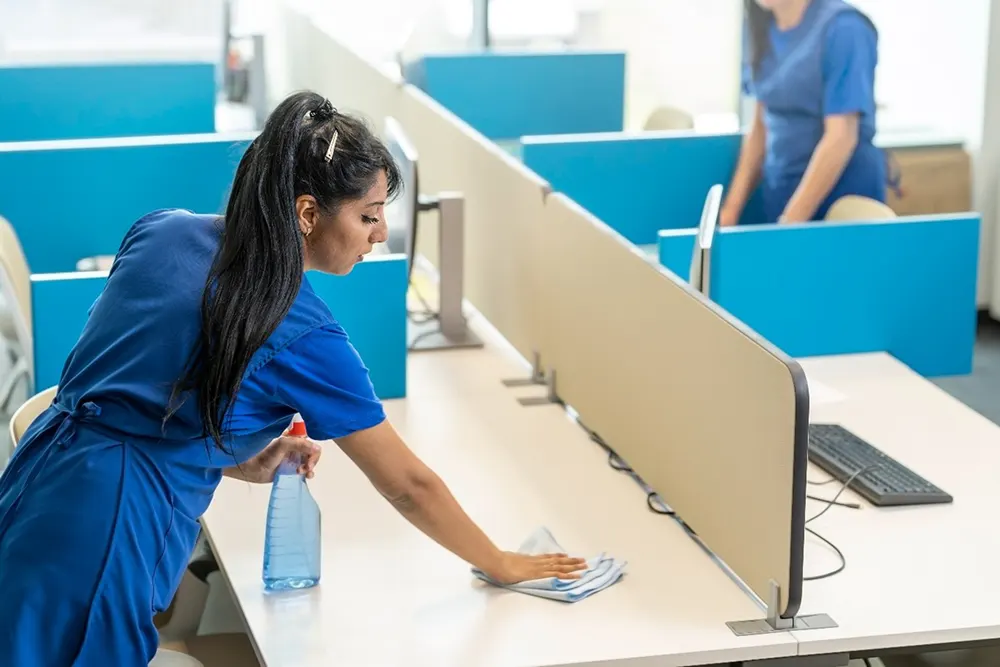
Photo: Invekta
Design and maintenance tip
Office space should radiate calm. Fewer unnecessary items on desks mean faster and more efficient cleaning. Strive to achieve a visual identity that favors clean lines and order.
Specifics of warehouse and logistics space maintenance
Unlike offices, warehouses require an industrial approach. This is not just about dust, but also workplace safety.
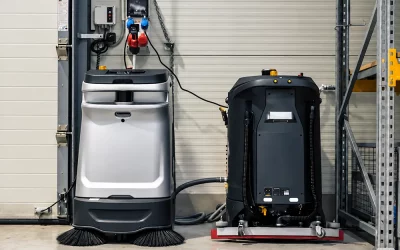
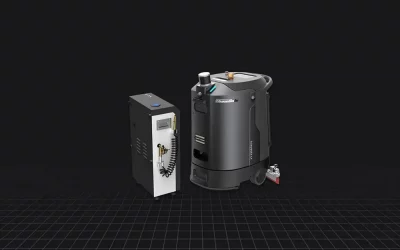
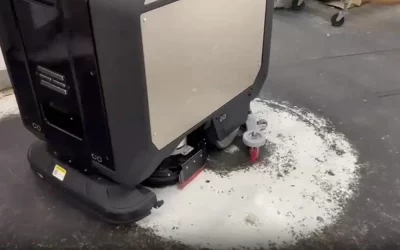
- Dust control: Industrial floors require machine cleaning to prevent particle buildup that can damage goods.
- Zone marking: Hygiene also includes maintaining the visibility of floor signage.
- Waste management: Timely removal of packaging waste prevents accumulation and potential fire hazards.
- Floor hygiene: First, collect all large waste (pallet debris, foil, trash). Then proceed with machine floor washing, followed by attention to edges that must be cleaned with mops to prevent mice or rodents from gathering. This is especially important for warehouses storing food.
- Separation of plastic and cardboard: Baling and sorting, then disposal into designated containers.
- Regular restroom cleaning: With modern dispensers equipped with software, staff receive notifications and respond promptly by replenishing supplies.
Cleaning as a process
What does office and warehouse hygiene maintenance look like in practice? Of course, the detailed specification and scope of work are individual and depend on each client’s needs.
Table: Maintenance frequency by zones
| Zone | Frequency | Method |
| Office desks | Daily | Disinfection with microfiber cloths |
| Glass surfaces | Weekly | Streak-free cleaning |
| Warehouse floors | Daily | Machine washing and vacuuming |
| Sanitary dispensers | Continuous | Inspection and replenishment |
Technology and hygiene: The future is automation
Modern hygiene no longer relies on intuition, but on data. The use of sensor devices provides insight into how frequently a space is used, optimizing the work of cleaning staff.
Office and warehouse hygiene maintenance – Environmental responsibility (Green Cleaning)
Modern business requires sustainability. The use of biodegradable products is no longer just a trend, but a standard in hygiene maintenance.
- Plastic reduction: Use of concentrated products that are diluted on-site.
- Efficient dispensers: Devices that control soap and paper consumption reduce waste.
- Use of green chemical products: Reduces environmental pollution.
How to choose a hygiene maintenance partner?
A hygiene maintenance partner can be selected in several ways. The B2B sector requires professionalism and discretion, and when choosing a service provider (company, agency, or team), focus on:
- Experience in your industry (especially if you have specific requirements such as medical standards or high-bay warehouses).
- Cost transparency (0 RSD initial investment in equipment through subscription models. 0 RSD capex. You only pay opex).
- Workforce quality: Trained staff who understand the importance of protocols.
- Software solution: Real-time employee performance tracking and task verification.
- Control manager: A person responsible for supervising completed work.
Manager checklist
To ensure your space is always at the highest level, follow this checklist:
- Are all restroom dispensers functional and full?
- Are shared spaces disinfected before the start of the workday?
- Are there accumulated layers of dust in hard-to-reach areas in the warehouse?
- Is the lighting clean (full brightness without dirt buildup on fixtures)?
The job specification and detailed list are created in agreement with the client according to their needs. They can also be created by the client before the tender.
Example from practice office and warehouse hygiene maintenance:
When we were engaged by Galenika a.d. from Belgrade, the issue was cleaning dust from high-bay shelving units and general cleaning of the warehouse space and roof structure:
- Removing cobwebs at heights over 10m
- Wiping shelving units at heights over 10m
- Removing and vacuuming ceiling and roof structure
- Cleaning the exterior of HVAC ducts
- Cleaning the metal structure of shelving and automated crane (crane structure)
- Cleaning ceiling lighting fixtures
- Dusting dome skylights
- Vacuuming concrete ceilings, sections of ribbed metal walls, and metal beams
- Cleaning external ventilation ducts and chambers, steam pipes and other piping, fluorescent lights, and supports
How did we help Galenika?
Given that warehouse cleaning is demanding due to work at height, Invekta provided a team specialized for working in difficult conditions, with all required medical certifications and licenses. In addition, Invekta ensured protective equipment in accordance with occupational health and safety standards for safe and uninterrupted work. Given that the space was large (9650m2), the entire job was completed within a few days to mutual satisfaction. The client expressed a desire to continue cooperation.
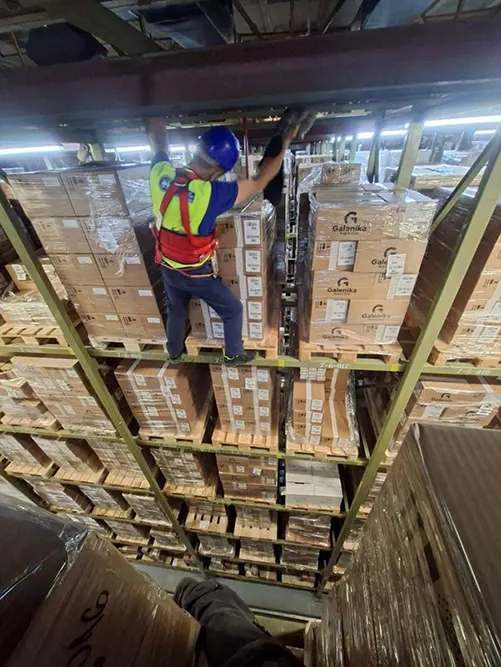
Photo: Invekta
Office and warehouse hygiene maintenance – Frequently asked questions (FAQ)
- How often should warehouse floors be machine washed?
Frequency depends on traffic intensity and type of goods, but for spaces with high forklift activity, daily maintenance is recommended to prevent industrial dust buildup.
- What does the “0 RSD Capex” equipment procurement model include?
This model allows companies to obtain the most modern machines, dispensers, and equipment without initial investment. The equipment is provided through a monthly subscription (Opex), which simplifies budget planning.
- Do you use products that are safe for IT equipment in offices?
Absolutely. We use specialized non-abrasive products designed for disinfecting workstations, keyboards, and monitors, eliminating bacteria without risking damage to electronics.
- How is quality control of completed work carried out?
Control is carried out on three levels: through real-time software monitoring, regular inspections by a control manager, and verification of checklists on-site.
- Does working at height in warehouses require special permits?
Yes. Our teams are trained and licensed for working at height. They possess all necessary medical certificates and use certified protective equipment in accordance with occupational health and safety regulations.
An investment that pays off multiple times
Office and warehouse hygiene maintenance is a continuous process that requires planning, quality equipment, and attention to detail. By focusing on solutions that are discreet yet effective, you create an environment where employees feel respected and clients recognize your professionalism.
Improve your standards today. Contact us for a free assessment of your facility. A clean space is not just a goal—it is the way your business breathes.
About the Author:
Biljana Šapić – Operations Director – Specialist in implementing hygiene standards and optimizing processes in facility maintenance. With a focus on operational excellence, Biljana manages teams that apply ISO and HACCP protocols in the most demanding work environments—from premium office spaces to production facilities. Her work is based on creating impeccable order that allows clients to focus seamlessly on their growth.
The expert articles on this blog are the result of a combination of years of field experience and advanced analytical data processing, with final author approval.

0 Comments