


Grocery stores such as self-service stores and supermarkets of all sizes are highly challenging facilities to maintain. Not only because of the high and constant flow of customers, but also because selling food and groceries inevitably leads to spills and dirty floors. That is why robotic cleaning in supermarkets and grocery stores is a cost-effective and efficient solution.
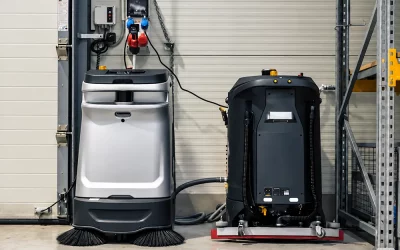
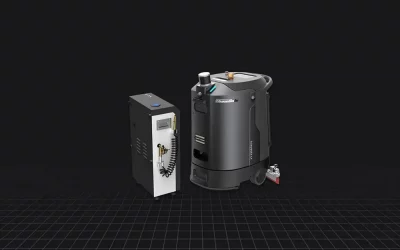
Invekta follows this trend through commercial cleaning robots and imports the CenoBots L3.
Why does customer traffic change the rules of the game for cleaning?
The retail area has a constant flow of customers during business hours. Shopping carts, as well as relocated shelves or seasonal promotions, change the layout from week to week. Manual cleaning during business hours disrupts customers and slows down checkout staff. That is why robotic cleaning works best when the route follows the actual hours of lower customer traffic. Not the store’s fixed business hours.
This is a fundamentally different challenge from warehouses or airports, where the layout is more predictable from day to day. A store changes every week. Sometimes even every day because of promotions.
Which areas of the store require special attention?
The warehouse and receiving area are among those that a robot covers exceptionally well. Owners often leave them out of the plan when they first consider automation. The route there is wider and more predictable than in the retail area. Combining the warehouse and retail area in one plan usually delivers a higher return on investment than automating only what the customer sees.
The main aisles between shelves and the edges of the retail area are also ideally suited to robotic cleaning thanks to their clearer geometry. Robots clean the areas around checkouts more effectively after closing, when there are no crowds or shopping carts in the way.
Some areas require more frequent passes because of the nature of the dirt itself, not because of customer density. Condensation around refrigerated display cases and freezers gradually accumulates throughout the day due to temperature differences. This area requires more frequent passes along the route, not just one cycle per day as in drier areas.
Mud and moisture from customers’ footwear make the store entrance the dirtiest area. Especially in rainy or snowy weather. This means more frequent passes through this particular area compared with quieter parts of the store. Entrance mats also quickly become saturated with dirt. Additional human inspection remains necessary regardless of how often the robot passes through this area.
How does the robot operate when the store is full of customers?
LiDAR sensors and the obstacle avoidance system detect a customer, shopping cart, or pallet of goods in the way. The robot slows down or navigates around the obstacle without stopping the entire route. This allows it to operate in high-traffic areas even during business hours. Not only at night. Areas with the highest customer density still benefit most from cleaning outside business hours. Maneuvering is easier for everyone then.
The article on choosing an autonomous robot for a commercial facility explains in detail how to select the right model for a specific store size and level of customer traffic.
Why does the robot not leave a wet trail, and is it safer than conventional floor cleaning?
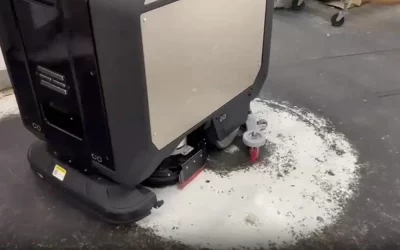
The robot washes and dries the floor in the same pass. The system immediately vacuums dirty water from the surface. Unlike a conventional mop or a single-stage floor-cleaning machine, it leaves no wet trail behind. There is no need for a warning sign or to wait for the floor to dry.
This directly reduces the risk of slipping. It is particularly important in a store where customers walk quickly. They often carry bags or push shopping carts while looking at the shelves. Not at the floor in front of them.
How do seasonal resets and changes to shelf layouts affect the robot’s route?
Every permanent change to the shelf layout requires the route to be remapped. Stores that frequently change their product layout should account for this step in advance as an ongoing maintenance requirement. Not as a one-time task when first introducing the system.
Seasonal assortment resets, changes to promotional islands, and temporary displays disrupt route stability the most in practice. How quickly the map can be updated after each such change often determines whether the robot remains a useful tool. Or becomes a source of frustration for staff after a few months.
Where should a robot not operate in a supermarket?
Restrooms and narrow and tall areas of stores remain beyond the reach of the autonomous system. The space simply does not allow the robot to maneuver without disrupting customers or damaging equipment.
Spilled liquid from damaged packaging or a broken bottle requires an immediate human response. The robot follows a predefined route and does not detect a sudden spill as it occurs. This is not merely an aesthetic issue. According to the National Floor Safety Institute, falls and slips account for more than one-fifth of all emergency room visits. Staff response time remains crucial regardless of how often the robot passes through that part of the facility.
Prepared food or deli departments often become greasy. This remains beyond the scope of the standard washing program. This area requires separate manual degreasing before the robot can even pass over the surface. Open asphalt parking lots, paths, and access areas also require maintenance without this type of robot. It is designed for enclosed commercial spaces.
What mistakes do stores most often make when introducing robots?
Choosing a model based solely on specifications without measuring narrow points on site often results in a robot that physically cannot pass through every part of the facility. Another common mistake is planning only for the retail area while neglecting the warehouse. Even though the warehouse is often an easier and more straightforward area to automate.
Another mistake is assuming that daytime operation automatically replaces the entire nighttime program without checking whether it disrupts customers. Likewise, changes to shelf layouts create an ongoing obligation to maintain the route. Buyers can easily overlook the importance of clear support for map changes and regular maintenance after the initial installation when purchasing a robot.
Robotic cleaning in supermarkets and grocery stores, a brief overview
Robotic cleaning in supermarkets and grocery stores delivers the best results when the facility is carefully measured first. The plan should include both the retail area and the warehouse. The robot model should be selected according to the actual geometry of the route and the frequency of layout changes. Not according to the store’s total floor area on paper. A properly configured system frees staff to work in areas the robot cannot cover and keeps the floor clean without disrupting business hours.
Robotic cleaning in supermarkets and grocery stores – Frequently asked questions (FAQ)
Does the cleaning robot operate while customers are in the store?
The robot can operate during business hours in areas with lower customer traffic. Most stores still schedule the main cleaning after closing or during the least busy hours. Checkout and entrance areas are usually cleaned only when no customers are present. The main aisles can also be maintained during the day without disrupting movement.
How often should the robot’s route be changed when the shelf layout changes?
Every permanent change to the shelf layout requires remapping. The robot follows a saved path through the facility. Stores that frequently change their product layout should account for this step as an ongoing maintenance requirement. More than a one-time task when first introducing the system.
Is a robot cost-effective for a smaller store or only for large chains?
Smaller stores and pharmacies often benefit greatly from a compact model designed for narrower spaces. The condition is that there are sufficiently repeatable routes to justify the investment. The size of the chain matters less than how stable and predictable the route in a specific store remains from week to week.
Can one robot cover both the retail area and the warehouse?
Yes. The warehouse and goods receiving area are among those that a robot covers well. The condition is that the geometry of the facility allows it and that both areas are included in the same layout plan. However, stores often make the mistake of planning only for the retail area while leaving the warehouse aside. A realistic implementation plan must cover both parts of the facility.
If you are considering introducing robotic cleaning in your store or retail chain, contact us and let us work together to determine which model best suits your facility.
About the author:
Jasna Drenovac – Copywriter and SEO content strategist – Content creation specialist. With a focus on facility management and hygiene maintenance services, Jasna develops blogs, hub content, and SEO. Her work combines years of experience in writing and editing with modern SEO standards.
The expert articles on this blog result from research, analytical processing, and editorial work by the author.

0 Comments