

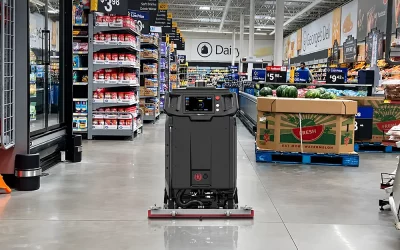
How does a cleaning robot check cleaning quality? When a janitor finishes a shift, a supervisor walks through the facility and checks whether everything has been done properly. A professional cleaning robot checks cleaning quality itself while it is working during the shift, not only after it finishes.
This question is especially important for facility managers introducing cleaning robots into commercial facilities. Responsibility for the cleaning standard remains with them regardless of who physically performs the work. A more detailed overview of the entire topic of robotics in commercial cleaning is available in the article Commercial cleaning robots.
What do the sensors actually measure while the robot is working?
The built-in cameras capture the condition of the surface before and after the brush or roller passes over it. The software compares these two images and calculates how much the surface has changed instead of assuming the job is complete as soon as the robot follows the assigned route.
With the professional machines imported by Invekta, this principle goes one step further: CenoBots identifies and classifies more than thirty categories of waste and dirt with 99% accuracy. It then adjusts the cleaning method to match each type. A grease stain is treated differently from dry sand or paper waste. There is no need for anyone to configure the robot separately for every situation.
How does the robot recognize that the surface is not clean enough?
Comparing the captured image with a reference standard is the foundation, but the system also monitors indirect indicators:
- how much dirty water has returned to the recovery tank
- how much the brush pressure has changed
- whether the rotation speed has slowed down because of resistance on the floor
If these parameters do not match the expected values for that type of flooring, the robot recognizes that something is wrong and changes its approach. For example, it extends the cleaning time for that area or returns to the same spot.
This approach is common in the professional cleaning industry and is not specific to a single model or manufacturer. Real-time sensor data analysis is used to detect uneven surfaces, obstacles, or operational deviations before they become visible problems.
Does a cleaning robot check cleaning quality during the shift?
Yes, and this is a part that is often overlooked: the machine regularly tests its own components, wheel speed, brush motor current, and the status of obstacle detection sensors. If any of these parameters deviates from the reference value, the system registers it as an error before it affects cleaning quality.
This type of self-diagnostics means that problems are rarely discovered only after the floor has been left uncleaned. The system reports any deviation as soon as it appears, whether it is a worn brush, a drop in tank pressure, or a sensor providing unreliable readings.
What happens when the robot detects a deviation from the standard?
Depending on the severity of the issue, the system responds in one of two ways.
- It resolves minor irregularities on its own by slowing down, repeating the cleaning pass, or adjusting the amount of cleaning solution.
- More serious faults, such as motor issues or a blocked brush, stop the operation and send a notification to the maintenance team with details and a recommended course of action.
This mechanism prevents a situation in which the robot continues operating incorrectly for hours until someone physically notices that something is wrong. The facility manager receives the information immediately, not during the next inspection of the facility.
How is cleaning quality data used after the shift is completed?
The system records and stores every cleaning pass, every deviation, and every correction as part of the operational history. This record is later used for planning: which areas require longer cleaning, where dirt returns the fastest, and when it is time to replace a consumable part such as a brush or filter.
For facility management teams that are accountable to clients for cleaning standards, this documentation proves that the work meets the defined criteria. It is not based solely on verbal confirmation.
How does a cleaning robot check cleaning quality – Frequently asked questions (FAQ)
Can a robot detect a stain that a person would not notice?
Yes, the sensors and cameras capture changes on the surface that the naked eye can easily overlook, such as a thin layer of grease or cleaning solution residue. By comparing images before and after the cleaning pass, the system detects differences in the appearance of the surface and adjusts the cleaning intensity for that section of the floor.
What if the cleaning quality sensor fails during operation?
Regular self-testing also covers this component. The fault is usually detected before it affects cleaning quality. If the readings become unreliable, the robot registers the issue as an error and notifies the maintenance team instead of continuing to operate with inaccurate data.
Is quality inspection the same for all types of flooring?
No. The reference values for pressure, speed, and the amount of dirty water depend on the type of surface. Terrazzo, ceramic tiles, and industrial concrete behave differently under the same conditions. The system uses parameters adapted to each flooring type so that the quality assessment remains accurate rather than generic.
Who receives the data when the robot detects a deviation?
The system sends a notification to the team responsible for operating and maintaining the robots in the field, usually through an app or monitoring software. The facility manager receives real-time status updates without having to physically inspect every part of the facility. How does a cleaning robot check cleaning quality.
Introducing robots into a commercial cleaning system also changes the way cleaning standards are monitored. Contact us for consultations tailored to your facility.
About the author:
Jasna Drenovac – Copywriter and SEO Content Strategist: A specialist in content creation. With a focus on facility management and commercial cleaning services, Jasna develops blogs, hub pages, and SEO content. Her work combines many years of writing and editing experience with modern SEO best practices.
The expert articles on this blog are the result of research, analytical evaluation, and editorial expertise.



0 Comments