

When a company decides whether to introduce robotic cleaning, the first misconception usually arises around whether there is one universal robot for everything. All Types of industrial cleaning robots differ according to their purpose. Just as much as conventional floor cleaning machines differ from one another. This directly affects how effective the cleaning process will actually be.
Invekta, through the CenoBots line it imports, works precisely according to this classification, avoiding offering clients a single solution for every type of commercial space. Learn more about how robotics and automation in cleaning truly work in practice.
What are the main types of cleaning robots available on the market?
Industrial cleaning robots are divided into three main categories based on how they operate.
- Floor scrubbing and washing robots (scrubbers) that use water, cleaning solution, and brushes or pads under pressure.
- Dry sweeping robots (sweepers). They collect dust, paper, and small debris using brushes and vacuum suction into a collection bin. Before scrubbing even begins.
- Robots for vacuuming carpets and soft floor coverings (vacuum). They are designed for areas that the first two types cannot clean. These three functions rarely come in one universal device without compromises.
Why aren’t scrubbing and sweeping robots combined into one machine?
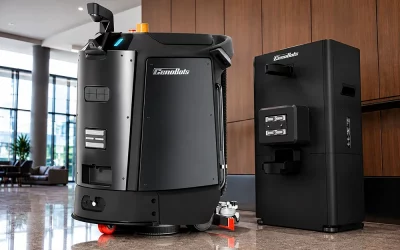
Combining both functions into one unit physically limits the size of the water tank and the dry waste bin. The machine requires emptying and refilling more often than when the functions are separated. The CenoBots L3 model imported by Invekta comes as a dedicated scrubbing robot for exactly this reason. A combined machine would have to compromise between the two tank capacities.
Separate functions allow sweeping to continue throughout the day. Scrubbing takes place once a day on an already swept surface, extending brush life and reducing equipment wear. Read more about how a robot monitors its own performance in the article how a professional cleaning robot automatically checks the quality of completed work.
How do you choose the right model based on the size of a commercial facility?
The size of the facility directly determines which model makes sense.
- Smaller facilities up to approximately 7,400 m² per shift are usually covered by an L4-class model.
- Medium and large facilities between 7,400 and 18,500 m² require an L50-class model or a combination of two smaller robots.
The more compact L3 model remains the better choice for narrower corridors and areas with frequent turns. Even if a larger model could theoretically cover more square meters per hour. Maneuverability often matters more than simply following a predefined route.
Are there specialized robots for disinfection?
Yes, the professional cleaning market also includes a separate category of robots designed for UV surface disinfection. They are separate from conventional floor washing and sweeping robots. These machines operate on a different principle. They use ultraviolet light instead of water and chemicals and are applied in environments where microbiological cleanliness takes priority over appearance.
What can’t these robots do regardless of their type?
No type of industrial cleaning robot can climb stairs. It cannot operate in water deeper than a few millimeters, and it does not respond instantly to unexpected liquid spills while moving.
Heavy grease stains still require manual pre-cleaning before the robot passes over the surface. Changes to the layout of furniture or shelving usually mean that the robot must remap its route. These limitations apply equally to scrubbing robots and sweeping robots.
Types of industrial cleaning robots: a brief overview
Types of industrial cleaning robots fall into three main functional categories:
- scrubbing
- sweeping
- carpet vacuuming
There are also specialized categories such as UV disinfection for specific applications.
The right choice is never “one robot for everything” but rather a combination of models tailored to:
- the size of the facility
- the type of flooring
- the type of dirt the company deals with every day
Companies that understand this before purchasing avoid the disappointment of a robot that “doesn’t do what was expected” simply because the wrong type was selected.
Types of industrial cleaning robots – Frequently asked questions (FAQ)
Can one robot perform both scrubbing and sweeping at the same time?
Technically, there are machines that combine both functions. However, they come with compromises in water tank and waste bin capacity. They require more frequent emptying and refilling. In practice, better results are achieved with two specialized robots operating in parallel. One performs dry sweeping throughout the day, while the other handles scrubbing once a day.
How many robot models does a company typically need for one facility?
The number depends on the size and layout of the facility. A smaller facility is often covered by one compact model. A larger complex or a facility with different surface types (warehouse plus office area) requires a combination of two different models tailored to each specific zone.
Can cleaning robots operate on multiple floors connected by an elevator?
A robot cannot automatically move between floors using an elevator without additional software. In practice, this usually means that each floor has its own unit or that staff manually move the robot between floors during a shift.
Are Types of industrial cleaning robots selected only according to the size of the facility?
The size of the facility is important, but it is not the only criterion. Corridor width, flooring type, cleaning frequency, and the type of dirt the company faces all have an equal impact on model selection. A robot that perfectly matches the floor area may still be a poor choice if the corridors in the facility are too narrow for its dimensions.
If you are not sure which combination of robots is the right fit for your commercial facility, contact us, and we will prepare a recommendation tailored to the type and size of your facility.
About the author:
Jasna Drenovac – Copywriter and SEO Content Strategist – Specialist in content creation. With a focus on facility management and cleaning services, Jasna develops blog articles, hub pages, and SEO content. Her work is based on a combination of many years of writing and editing experience and modern SEO standards.
The expert articles on this blog are the result of research, analytical evaluation, and editorial work.

0 Comments