


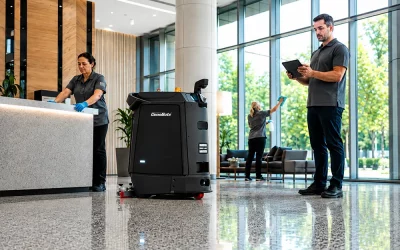
Office buildings are usually empty in the evening, making that the easiest time to maintain them. This creates the perfect opportunity for nighttime office cleaning robots without disrupting employees in any way. The question companies ask most often is not whether it is possible, but what efficient machine operation without human supervision actually looks like. Data on specific savings and all the benefits of maintenance come immediately after they see that robotic cleaning is reliable and consistently delivers the same results.
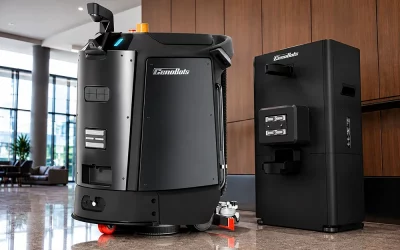
Invekta, through the CenoBots L3 cleaning robot, addresses exactly this scenario in commercial buildings. The entire approach relies on robotics and automation in cleaning specifically adapted for unsupervised nighttime operation.
What does a typical nighttime robot route in an office look like?
The robot leaves the docking station at a scheduled time. It follows a mapped route throughout the building and returns for charging after completing its assigned zone. The basic principle behind how the robot follows its route and recognizes the environment is explained in more detail in the article how a professional cleaning robot works.
The lobby, atrium, and open office areas usually come first because they are the largest spaces and the easiest for the robot to clean. The route to the elevator follows immediately afterward. Corridors with hard flooring, the cafeteria, and meeting rooms are cleaned during the final part of the shift, when the building is already completely quiet.
Which areas are best suited for nighttime robotic cleaning?
Open spaces with hard floors and a predictable furniture layout deliver the best results. The robot follows the same route without obstacles, unlike offices where the positions of chairs or smaller objects on the floor change from day to day.
Ground-floor parking areas and corridors leading to the elevators are also among the most reliable and easiest zones for floor maintenance.
The building gym and meeting rooms are cleaned effectively, but they require the doors to remain open during the scheduled cleaning period. This is a small organizational detail that often determines the success of the entire route.
What can’t the robot cover during the night shift?
Carpeted areas remain completely outside the capabilities of a floor-scrubbing robot. The L3 is designed for hard floor surfaces. Restrooms still require manual cleaning, as does anything that involves climbing stairs. Cluttered floors slow the robot down and require employees to avoid leaving boxes or chairs in its path. Although the robot detects and avoids obstacles, they interfere with its ability to follow the planned route.
Unexpected liquid spills during the day still require a human response rather than the robot’s nighttime route. To learn where the work of cleaning staff and robots differs and where they complement each other, read the article Robot or human: where robotic cleaning performs better and where human work remains essential.
How does the schedule adapt to different types of building tenants?
A standard office operating from 9 a.m. to 5 p.m. has the simplest schedule. The entire space becomes available after business hours, allowing the robot to clean the building in one continuous session.
In multi-story buildings, the usual practice is for staff to move the robot by elevator to the floor scheduled for that night at the end of the shift. The following night, it moves to the next floor, allowing the entire building to be covered in rotation over several days. Of course, this assumes that the autonomous machine can clean an entire floor on a single battery charge. This limitation can also be easily solved by installing additional charging stations on every floor.
Co-working spaces with late-working users usually shift the robot’s entire route to later at night. This avoids frequent changes to the floor schedule. Companies operating 24/7 follow the same rotation principle, adjusted according to which floor is currently unoccupied.
Why is consistency more than just a marketing phrase?
The robot follows the exact same mapped path every time, using the same brush pressure and the same route regardless of how demanding the previous shift was. Manual cleaning teams working under time pressure and fatigue often skip corners. They rush through less visible parts of the building, while the robot does not make that distinction.
After a pilot period with robotic cleaning, the British facility management company Mitie reported a 23% improvement in team productivity by using robots that operate primarily at night. The building is cleaned while empty, without disrupting employees during the workday.
Nighttime office cleaning robots: a brief overview
Nighttime office cleaning robots perform best when the route is adapted to the type of tenant. Open areas with hard flooring receive priority. Companies quickly embrace the change once they see the results of robotic cleaning. Carpets, restrooms, and unexpected spills remain tasks for human staff.
During the first few weeks, employees notice the robot as something new. After a short period, it becomes part of the building’s background while staff shift their attention to the details the robot does not cover.
Nighttime office cleaning robots – Frequently asked questions (FAQ)
Is nighttime robotic cleaning safe when the building is completely empty?
The robot follows a pre-mapped route and uses sensors that stop it when obstacles appear. Therefore, an empty building does not present a safety issue. Greater attention is given to the building’s security outside business hours (alarm systems or access control), which is a separate matter from the robot’s operation and is handled through standard physical security measures.
How long does it take to introduce a robot into a new office building?
Initial mapping of the space usually takes between one and three days per floor. It depends entirely on the size of the area and the complexity of the furniture layout. Once the map is complete, the robot immediately begins following its route. Additional schedule adjustments are made during the first weeks of operation until any unforeseen obstacles have been resolved.
What happens to the robot when employees work overtime?
The robot’s schedule is simply moved to a later time, or the route is divided into zones. The robot avoids the part of the building where people are still present. For buildings with frequent overtime work, defining a flexible cleaning window in advance is more practical than setting a fixed start time. This avoids the need to constantly adjust the schedule manually.
Does the robot’s schedule change when the building has multiple tenants?
Each tenant usually has its own working hours and specific requirements. In practice, this most often means that the floor-by-floor rotation is adjusted according to which part of the building is currently empty. This works better than using one fixed schedule for the entire building. A portfolio of buildings with multiple tenants usually requires planning the schedule for each floor separately, according to that tenant’s specific working hours.
If you manage a commercial building and are considering how nighttime office cleaning robots would work in your facility, contact us, and we will prepare a schedule tailored to your tenants.
About the author:
Jasna Drenovac – Copywriter and SEO Content Strategist – Specialist in content creation. With a focus on facility management and cleaning services, Jasna develops blog articles, hub content, and SEO content. Her work is based on a combination of many years of writing and editing experience and modern SEO standards.
The expert articles on this blog are the result of research, analytical processing, and editorial work.


0 Comments