


Why aisle width matters when choosing a cleaning robot? Aisle width is an important parameter when choosing a cleaning robot because it determines whether the robot can physically access the planned area and manoeuvre safely in a confined space. A robot that delivers excellent hourly performance on paper has little value if it cannot enter half of the aisles in the facility. Therefore, aisle width should be one of the first selection criteria, not the last.
Two facilities with the same floor area can have completely different automation requirements, depending on whether the space is open or divided by narrow corridors, shelving and doors.
Why is floor area alone not enough when choosing a cleaning robot?
Floor area shows how much flooring needs cleaning, but it does not show how that area is organised. The layout itself determines whether the robot can reach all the planned zones. Therefore, a large floor area does not automatically require the largest available model.
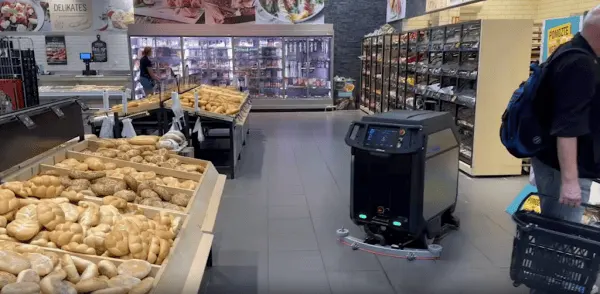
In a warehouse with wide transport corridors, a larger robot has enough room to move and turn. In a supermarket, hospital or office facility with a similar floor area, shelving, equipment, doors and narrower corridors often make the layout considerably more complex.
A space assessment should therefore answer two separate questions, rather than focusing solely on the total floor area:
- How much floor area does the robot need to maintain?
- Can it move through all the zones that make up that area?
How does the minimum aisle width determine which CenoBots model can operate in a facility?
The minimum aisle width shows how narrow a section of the facility the robot can navigate given its dimensions. If an aisle is narrower than this requirement, the robot cannot clean that zone, regardless of its performance or the facility’s total floor area. This specification therefore provides a more practical way to select a model than cleaning power or speed alone.
For example, according to its official specifications, the CenoBots L3 requires a minimum aisle width of 700 mm and has a cleaning width of 400 mm, making it suitable for shops, hospitals, schools and commercial buildings with narrower aisles and corridors.
Models designed for more open spaces, such as the CenoBots L50 with its 510 mm cleaning width, have a different priority- greater capacity and wider coverage with each pass, based on the assumption that facilities of this type generally have wider aisles.
Why is manoeuvring space not the same as aisle width?
The robot’s physical width, cleaning width and minimum aisle width are three separate specifications. None of them alone guarantees that the robot can operate efficiently in a particular space because an aisle that provides enough room for straight-line movement may not offer enough room to turn at the end of a corridor or around a shelf.
Therefore, when selecting robots for warehouses and other complex spaces, CenoBots also considers the turning radius, rather than focusing only on the robot’s external dimensions.
Shelving, columns and equipment further divide a large area into a series of smaller work zones. The robot does not “see” the facility as a total number of square metres but navigates its specific aisle layout. Consequently, the narrowest points and the places where the robot must change direction or turn provide more useful information for model selection than the width of the facility’s longest corridor.
To see how the CenoBots L4 navigates narrow aisles between supermarket shelves, watch the video.
When is a larger robot a better choice than a compact model?
A larger robot makes sense when a facility has sufficiently wide, open areas and the main priority is cleaning large zones without the restrictions created by narrow aisles. In this case, parameters such as cleaning width, tank capacity and hourly performance become more important. A compact model gains an advantage whenever the layout restricts movement, regardless of the facility’s total floor area.
Table: CenoBots robot width, working width and minimum aisle width
| CenoBots model | Robot body width | Cleaning / sweeping width | Minimum aisle width | Aisle wider than the body by | Minimum turning width |
| L3 | 572 mm | 400 mm | 700 mm | 128 mm | Not specified separately |
| L4 | 615 mm | 450 mm | 810 mm | 195 mm | 1.100 mm |
| L50 | 580 mm | 510 mm | Not specified | – | Not specified |
| S5 | 720 mm | 820 mm | 810 mm | 90 mm | Not specified |
| SP50 | 600 mm | 720 mm | 800 mm | 200 mm | 1.200 mm |
What should you measure in a facility before choosing a cleaning robot?
A space assessment should evaluate the robot’s ability to move and manoeuvre under real operating conditions, rather than focusing only on its external dimensions. NIST methods for assessing robot performance treat mobility and manoeuvring as distinct categories, confirming that aisle width alone does not provide enough information for a reliable assessment.
A practical assessment should cover:
- the minimum aisle width along the planned routes
- doors and other narrow passage points
- the space at the ends of aisles
- zones where the robot must change direction
- the position of fixed obstacles and equipment
- the total area designated for autonomous cleaning
- and sufficient space for the charging station if the robot uses automatic docking
Only after completing this step does it make sense to compare the technical specifications of individual models.
Why aisle width matters when choosing a cleaning robot – FAQ
Does the robot need to pass through every aisle in the facility?
Not necessarily. If the goal is for the robot to cover the main cleaning zones used regularly, it only needs to access those aisles. Narrower ancillary rooms or occasionally used passageways can remain part of the manual cleaning routine without reducing the value that automation provides throughout the rest of the facility.
Should doors and thresholds undergo separate checks when measuring the space?
Yes. You should measure door widths separately because they may be narrower than the corridors they connect. A threshold, on the other hand, does not primarily affect aisle width but presents an obstacle that the robot must physically cross. Therefore, you should check both factors when assessing the route.
Can a facility use both a compact and a larger model because of differences in aisle width?
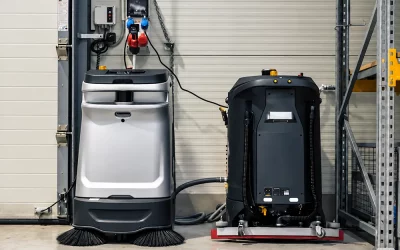
Yes. In facilities with mixed layouts, a more compact model such as the L3 can cover narrower zones and corridors, while a larger model such as the L4 or L50 handles the more open areas. This combination is common when no single model suits every part of the facility equally well.
Should the charging station’s width also form part of the space measurements?
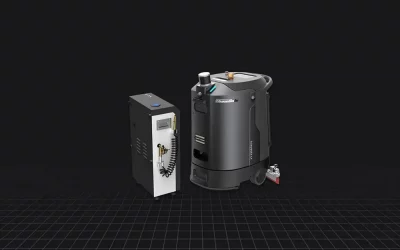
Yes. The automatic charging and water refill station occupies its own space and requires an accessible approach for the robot. Therefore, you should include its position and dimensions in the same space assessment as the aisles that the robot regularly uses.
If you are unsure whether the width of your aisles is suitable for any of the CenoBots models, we can review your facility’s basic measurements together and recommend a combination that can realistically access all the zones designated for automatic cleaning.
About the author:
Milja Tonić – SEO Content Strategist & Copywriter
Milja Tonić is an SEO Content Strategist and Copywriter who specialises in creating expert content on facility management, the professional maintenance of commercial facilities and the automation of cleaning processes.
Through research, SEO strategy and original writing, she develops content about professional hygiene, facility management and the use of autonomous cleaning robots in various commercial environments.

0 Comments