

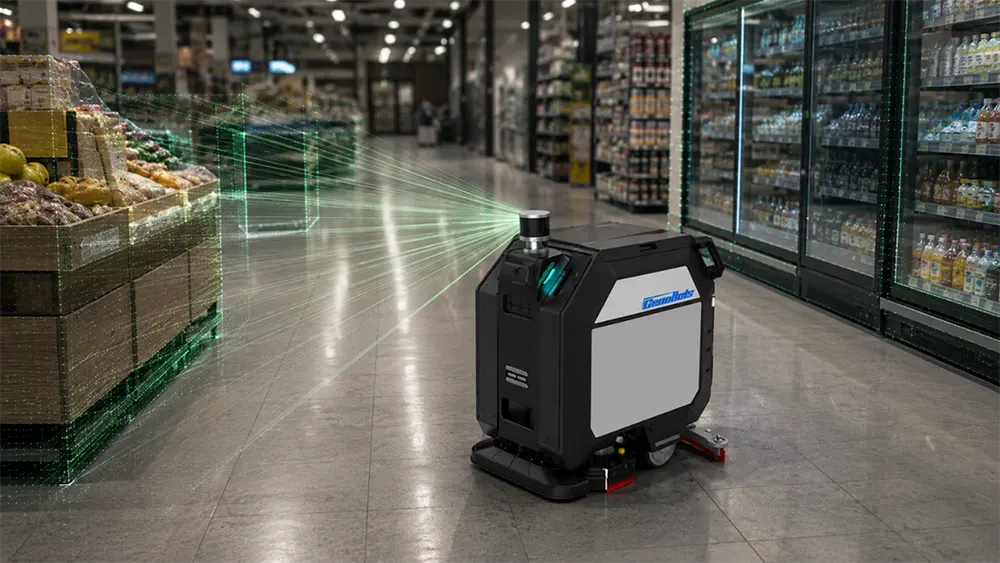
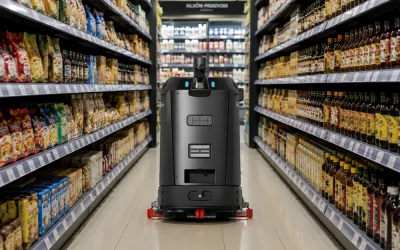
What is LiDAR and why do cleaning robots use it? LiDAR (Light Detection and Ranging) is a technology that uses laser pulses to measure the distance between a robot and objects in its environment. Autonomous cleaning robots use it to map spaces, determine their position, plan routes, and detect obstacles. Combined with cameras, other sensors, and an AI system, it enables the robot to navigate commercial facilities independently.
Therefore, an autonomous robot needs more than the ability to “know” how to scrub, sweep, or vacuum a floor. To perform tasks without constant operator control, it must understand where it is, where it needs to go, and what lies in its path.
This is precisely where LiDAR becomes one of the key elements of an autonomous navigation system. In commercial cleaning robots, it does not operate independently but forms part of a broader system that includes 3D cameras, sensors, mapping software, and an NVIDIA AI computing platform.
How does LiDAR help a robot create a map of a space?
The data collected by LiDAR enables the navigation system to identify the geometry of a space and create a digital map of the facility. Using SLAM technology, the robot simultaneously builds or updates the map and determines its own position on it. This allows it to plan the cleaning of specific zones and track its movement through the facility.
SLAM stands for Simultaneous Localization and Mapping.
In practical terms, the robot must solve two related problems: “What does the space around me look like?” and “Where am I currently located within that space?”
Once the robot has a map and knows its own position, the software can plan a route for covering the designated zone and adjust its movement to the conditions in the space.
Why is LiDAR alone not enough for a robot?
LiDAR provides essential information about distances and the surrounding space, but an autonomous cleaning robot uses several sources of information simultaneously. Robots combine 3D LiDAR with depth cameras and other sensors, while an AI computer processes the collected data. This combination of sensors helps the robot better understand complex and changing environments.
Developers also use this approach when creating other autonomous mobile robots. As part of the European CROWDBOT research project, CORDIS describes combining LiDAR, depth sensors, and other sensors with processors and intelligent algorithms to map and localize robots, plan their movement, and improve their understanding of the environment.
The CenoBots L3, for example, combines a 96-channel 3D LiDAR with an AI platform to navigate, plan routes, and avoid obstacles, including floor-level hazards such as cables and temporary mats.
How does LiDAR help a robot avoid obstacles?
LiDAR helps the robot detect nearby objects and assess their position in relation to its route. When the navigation system identifies an obstacle along the planned route, the robot can slow down, stop, or adjust its path. Cameras and additional sensors provide information that complements the LiDAR data.
Does LiDAR enable a robot to operate in a changing environment?
LiDAR and other sensors enable the robot to collect information about its environment continuously, so its navigation does not rely solely on an initial representation of the space. When a temporary obstacle appears or the layout changes, the system can detect the change and adjust the robot’s movement. Certain CenoBots functions also allow the robot to update the information it uses for navigation.
This marks an important difference between autonomous cleaning and moving a machine along a completely fixed route.
In a real facility, someone may move a chair, temporarily block a passage, leave a pallet in a different location, or drive a vehicle into the robot’s path.
This capability is particularly important for the CenoBots S5 in warehouses and industrial facilities. The model uses a 32-channel 3D LiDAR, an NVIDIA AI platform, and functions that adapt to dynamic environments, allowing it to operate in spaces where layouts and traffic patterns change during operation.
What type of LiDAR do CenoBots cleaning robots use?
CenoBots models use multi-channel 3D LiDAR systems, but the specifications vary between robots. The L3 uses a 96-channel 3D LiDAR, while models such as the S5 use a 32-channel 3D LiDAR. Therefore, you should not consider the number of channels in isolation but assess it alongside the cameras, sensors, AI computer, and complete navigation system of the specific model.
| Model | LiDAR / navigation system |
| CenoBots L3 | 96-channel 3D LiDAR + additional sensors |
| CenoBots L4 | 32-channel 3D LiDAR + 3D depth camera + bumper + IMU, range of up to 150 m |
| CenoBots L50 | 32-channel 3D LiDAR + depth cameras, range of up to 150 m |
| CenoBots S5 | 32-channel 3D LiDAR, range of up to 150 m + sensor system |
| CenoBots SP50 | 32-channel 3D LiDAR, range of up to 150 m + 3D depth camera + bumper + IMU |
For the S5, for example, the manufacturer specifies a 32-channel 3D LiDAR with a range of up to 150 metres, connected to a 100-TOPS NVIDIA AI platform.
These specifications do not mean that the robot “uses all 150 metres” as its working area during cleaning. The range represents a technical characteristic of the sensor; practical navigation depends on the layout of the space and the complete perception system.
What is LiDAR and why do cleaning robots use it?- FAQ
What is the difference between LiDAR, cameras, and an AI system in a robot?
LiDAR, cameras, and AI perform different functions. LiDAR primarily provides spatial and distance data, cameras provide additional visual and depth information, and the AI computer processes the data and supports movement-related decisions. Working together, they enable the robot to map spaces, plan routes, recognize situations, and respond to obstacles during cleaning.
Is LiDAR enough when choosing a cleaning robot?
No. LiDAR plays an important role in navigation, but it alone does not determine how well a robot will suit a specific facility. When choosing a robot, you should consider the type of cleaning, passage width, cleaning width, productivity, capacity, operating time, sensor system, and conditions in the space where the robot will perform its daily tasks.
Can LiDAR “see” through walls or transparent surfaces?
No. LiDAR measures distance based on the reflection of a laser pulse, so walls and opaque obstacles block it just like any other object. Transparent or highly reflective surfaces, such as glass, can challenge LiDAR when it operates alone. For this reason, CenoBots robots also use depth cameras and sensors that help them detect such surfaces.
Does LiDAR consume a lot of energy and affect the robot’s operating time?
LiDAR operates continuously while the robot works, but it forms part of the device’s broader energy requirements, alongside the motors, pumps, and AI computer. The total operating time of CenoBots models – from several hours to more than five hours, depending on the model – already accounts for the operation of all these systems, including LiDAR.
The best way to understand LiDAR is to see how a robot responds to a real environment. If you want to see how CenoBots maps its surroundings, detects obstacles, and independently plans its movement, schedule a demonstration.
About the author:
Milja Tonić – SEO Content Strategist & Copywriter
Milja Tonić is an SEO Content Strategist and Copywriter who specializes in creating expert content on facility management, professional maintenance of commercial facilities, and the automation of cleaning processes.
Through research, SEO strategy, and original content development, she creates content about professional hygiene, facility management, and the use of autonomous cleaning robots in various commercial environments.

0 Comments