

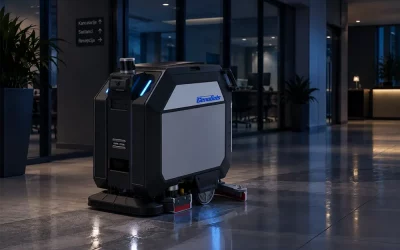
How much water does a cleaning robot use per square meter? The water consumption of robots for cleaning commercial premises does not have a single fixed value per square meter. It depends on the model, selected flow rate, travel speed, floor type, level of soiling, and cleaning mode. Autonomous floor-scrubbing and drying robots dispense water in a controlled manner and, after washing, vacuum the dirty water into a separate tank.
Therefore, the tank capacity should not be equated with water consumption. A robot with a 55-liter tank will not automatically use all 55 liters on the area it can clean in one hour.
In professional robots, the dosing system determines how much solution reaches the brush, while travel speed, settings, and floor conditions affect actual consumption.
Approximately how much water per m² do different robot models use?
For the CenoBots L3, L4, and L50, the manufacturer does not specify a separate fixed water consumption per m². As an indicative range for commercial floor-scrubbing and drying robots, CenoBots states approximately 54–108 ml/m². Different models can operate within this range, while actual consumption depends on the selected flow rate, travel speed, and cleaning conditions.
How does a cleaning robot use water?
A floor-scrubbing and drying robot uses water through a controlled process: clean water and detergent come from a dedicated tank, the dosing system delivers the required amount to the brush, and after washing, the vacuum system collects dirty water from the floor and transfers it to a separate wastewater tank.
What water tank capacities do the CenoBots L3, L4, and L50 have?
The CenoBots L3 has a 25 L solution tank, the L4 has a 38 L tank, while the L50 has a 55 L tank. A larger tank allows the robot to operate longer between refills, but its capacity alone does not indicate how much water the robot uses per square meter because water consumption also depends on how the system dispenses it.
| Model | Solution tank | Scrubbing width | Max. theoretical productivity |
| CenoBots L3 | 25 L | 400 mm | 2,016 m²/h |
| CenoBots L4 | 38 L | 450 mm | 1,944 m²/h |
| CenoBots L50 | 55 L | 510 mm | 2,203 m²/h |
How does the CenoBots L4 control water consumption?
The CenoBots L4 uses the Smart Flow function, which adjusts the solution flow rate to the robot’s travel speed. Its purpose is to reduce unnecessary water and detergent consumption while keeping solution application aligned with how the robot cleans the floor. Therefore, the amount of water depends on the machine’s movement.
This is particularly important when the robot changes speed during operation.
If it moves through a more complex part of the facility, navigates around obstacles, or works in an area where it cannot maintain the same speed as it can in an open space, the system can adjust the flow rate.
How does the CenoBots L50 reduce unnecessary water consumption?
The CenoBots L50 has a 55-liter solution tank, and the manufacturer specifically lists Save Water and Save Detergent among its sustainability features. This shows that the model’s design incorporates water and detergent management.
Can the CenoBots L3 refill its water automatically?
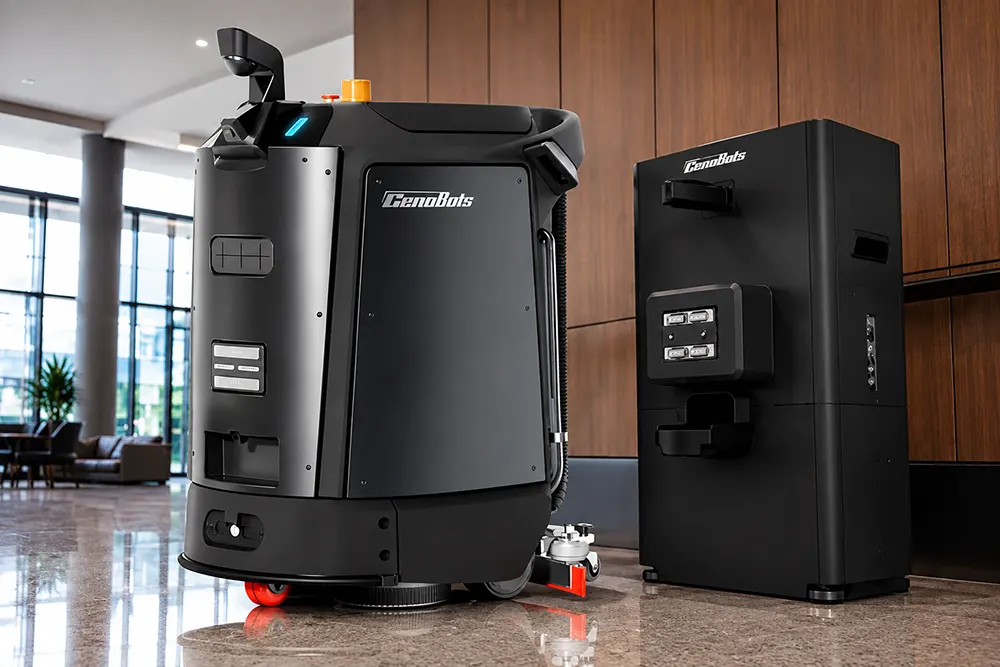
Yes. The CenoBots L3 can work with the WS3 Workstation, which automates battery charging, water refilling, wastewater drainage, and detergent replenishment.
The article about the battery and automatic charging of cleaning robots explains the entire process of returning to the workstation in greater detail.
For facilities without a conveniently accessible water connection, the WT3 Mobile Water Tank can extend operating time without relying on nearby fixed plumbing.
The WT3 has a capacity of 60 liters for clean water and 50 liters for wastewater.
This is important in facilities where the robot operates far from the utility room or where installing the workstation directly next to the existing water supply and drainage system would be impractical.
Instead of requiring staff to carry water to the robot frequently, the mobile tank brings the necessary infrastructure closer to its working area.
How do the L4 and L50 refill and drain water?
The L4 can use an optional 4-in-1 workstation that automates battery charging, clean water refilling, wastewater drainage, and detergent replenishment. CenoBots uses the same automated water management concept to extend the autonomous operation of scrubber robots because it reduces the need for staff to service the tanks manually between tasks.
The principle is simple: the robot completes part of its work cycle and travels to the appropriate workstation, where the infrastructure performs routine tasks that an operator would handle when using a conventional machine.
For the L4, CenoBots explicitly specifies an optional 4-in-1 Workstation with four functions:
- battery charging
- clean water refilling
- wastewater drainage
- detergent replenishment
This does not necessarily reduce the number of liters required to wash a particular floor, but it reduces interruptions and the amount of manual work required for water management.
How much water does a cleaning robot use per square meter?- FAQ
Where does the dirty water collected by the robot go?
The dirty water does not return to the clean water tank. After the solution and brush clean the surface, the squeegee directs the water toward the vacuum system, which lifts it from the floor and transfers it to a separate recovery tank. When the tank needs emptying, the designated drainage system removes the wastewater.
How can you calculate actual water consumption per m²?
The most reliable method involves taking measurements during operation in the specific facility. You need to record the amount of water or solution the robot uses and the area it actually cleans during that time. You can then calculate consumption using the following formula: amount of water used in liters ÷ cleaned area in m² = L/m².
For example:
50 L ÷ 800 m² = 0.0625 L/m²
or:
62.5 ml/m².
You can repeat this measurement for different modes or areas of the facility.
This approach,tracking resource consumption per unit of cleaned area, also aligns with the recommendations of the ISSA (International Sanitary Supply Association) for measuring professional cleaning efficiency, which advises facility managers to rely on data from their own facilities instead of generalized average values.
In this way, the facility manager obtains information that is far more useful than a general average because it shows how the robot performs on that specific floor, with the actual level of soiling and selected settings.
Do all CenoBots robots use water?
No. The L3, L4, and L50 scrubber-dryer models use water for washing. The CenoBots S5 is an autonomous sweeper designed for dry sweeping and waste collection, while the SP50 uses vacuuming, sweeping, and AI Spot Cleaning. Because these models use different cleaning technologies, water consumption per m² does not provide a relevant metric for all five CenoBots models.
Specifications do not reveal actual water consumption; the space where the robot operates does. Let us assess together what your facility needs and which CenoBots model fits it best.
About the author:
Milja Tonić – SEO Content Strategist & Copywriter
Milja Tonić is an SEO Content Strategist and Copywriter who specializes in creating expert content about facility management, professional maintenance of commercial facilities, and the automation of cleaning processes.
Through research, SEO strategy, and original content development, she creates content about professional hygiene, facility management, and the use of autonomous cleaning robots in different commercial environments.

0 Comments