


Garage and parking lot cleaning robots face challenges far beyond ordinary floor cleaning. First of all, they deal with much tougher dirt. They frequently encounter dangerously slippery motor oil stains. The environment includes steep ramps, transitions, and narrow passages around constantly moving vehicles. Cars bring in mud and dust that require continuous cleaning.
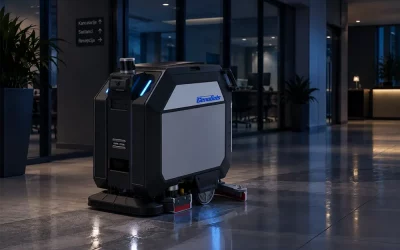
All of this has been taken into account for the commercial cleaning robots CenoBots L3 imported by Invekta. This model effectively covers small and medium-sized garage facilities. Its operating principle remains similar to that used in other commercial properties, as described in the article how a professional cleaning robot works. The autonomous AI machine takes the unique characteristics of each parking lot or garage into account when creating its route and plans the most efficient cleaning process.
Why do garages and parking lots require a different cleaning approach?
Garage traffic lanes create challenges such as motor oil leaks. Tire marks are difficult to remove manually. During winter, salt along with large amounts of dust and dirt brought in by vehicles requires constant cleaning at all times. On top of that, vehicles and people move unpredictably throughout the entire garage.
Concrete and epoxy flooring react differently to cleaning chemicals than ceramic or vinyl floors. For that reason, the cleaning schedule and detergents used by autonomous robots must be adapted to this specific combination of materials and demanding floor maintenance requirements. The robot monitors the quality of its own work throughout the cleaning route.
Which parking areas does the robot clean most effectively?
Traffic lanes and areas in front of elevators, staircases, and entrances are excellent candidates for robotic cleaning. They feature predictable layouts and regular vehicle movement patterns. Pedestrian zones within garages also perform well. The robot handles ramps with slopes of up to ten degrees without difficulty, while steeper inclines still require manual cleaning.
A single garage level with 400 parking spaces typically covers between 7,400 and 11,150 m² per floor. For comparison, a manual cleaning crew can cover approximately 1,850 to 2,800 m² per hour under ideal conditions, but garages rarely provide ideal conditions for maintaining that pace. A robot designed for dry cleaning can clean a level of approximately 9,300 m² within two to three hours during periods of lower traffic.
You can learn where people perform better and where robots excel in the article where robotic cleaning is more effective and where human work remains essential.
What challenges make cleaning garages and parking lots more difficult?
Motor oil stains require a dedicated degreaser, while heavier stains must be manually pre-treated before the robot can clean the surface. During winter, salt carried in by vehicles accumulates inside the robot’s recovery tank and requires more frequent rinsing than during the summer months. Puddles and standing water deeper than 10 mm represent the limit beyond which the robot cannot operate safely.
Where should the robot not operate?
Staircases remain completely beyond the capabilities of any floor cleaning robot without exception. Walls, columns, and curbs also require manual cleaning because the robot cleans only horizontal floor surfaces. Narrow mechanical rooms less than 600 mm wide remain a better choice for manual cleaning than for any robotic model.
How is the cleaning schedule planned according to garage occupancy?
Instead of waiting for the garage to become completely empty, the schedule is based on the percentage of occupied parking spaces. Most cleaning typically takes place between 11 p.m. and 5 a.m., when vehicle traffic is at its lowest. This approach is more efficient than waiting for the rare moment when the garage contains no vehicles at all.
Which robot model is best for a large parking lot?
A smaller garage facility usually achieves sufficient coverage with a single L3 model thanks to its compact dimensions and easier maneuverability between columns. A larger multi-level complex requires a larger machine from the same product line or even a combination of models for different floors. Invekta currently imports the L3, so the recommended solution for small and medium-sized garages is based on this model.
Garage and parking lot cleaning robots – a brief overview
Garage and parking lot cleaning robots perform best when their schedule follows actual occupancy levels instead of fixed facility operating hours. Traffic lanes, ramps with slopes of up to ten degrees, and pedestrian zones are ideal for automation. Staircases, walls, and narrow mechanical rooms remain tasks for human cleaners. A more detailed explanation of selecting the right model is available in the article about choosing an autonomous robot for a commercial facility.
Garage and parking lot cleaning robots – Frequently asked questions (FAQ)
Can the robot operate while vehicles are in the garage?
The robot performs most of its work at night when vehicle traffic is at its lowest. The schedule is based on the garage occupancy rate instead of waiting until the facility becomes completely empty. During the day, it can operate in areas with fewer vehicles without disrupting traffic inside the facility.
How does the robot clean oil stains?
The robot removes lighter oil stains using a degreaser included in its standard cleaning program. Heavier deposits and older stains require manual pre-treatment before the robot can clean that area.
Can the robot clean an open rooftop parking lot?
Not to the same extent as a covered parking facility. An open rooftop parking lot is exposed to rain, sunlight, and temperature changes, which affect both the cleaning chemicals and equipment wear. Traditional outdoor maintenance is usually used for these areas instead of robotic cleaning.
How often should a garage change the robot’s cleaning schedule?
During winter, the recovery tank requires more frequent rinsing because of salt carried in by vehicles, while the summer season brings less contamination. Any permanent change to the parking layout or ramps also requires the route to be remapped before the robot continues operating according to the existing schedule.
If you are considering introducing robotic cleaning to your facility’s garage or parking lot, contact us, and let’s determine together which model best suits your facility.
About the author: Jasna Drenovac – Copywriter and SEO Content Strategist – Specialist in content creation. With a focus on facility management and hygiene maintenance services, Jasna develops blogs, pillar content, and SEO content. Her work combines many years of writing and editing experience with modern SEO standards.
The expert articles on this blog are the result of research, analytical processing, and editorial work by the author. linkedin.com/in/jasna-drenovac



0 Comments