


Why are more large facilities using cleaning robots? More and more large facilities are introducing cleaning robots because large areas require many working hours, while production, logistics, customers and employees often limit the time available for floor maintenance. Autonomous robots take over repetitive washing, drying, sweeping or vacuuming tasks and perform them according to a schedule and predefined parameters.
In factories, logistics centres, warehouses, shopping centres and other large facilities, floor area alone does not indicate how demanding the cleaning process will be. The number of daily cleaning cycles, shift duration, the intensity of pedestrian and vehicle traffic, the type of dirt and the length of time a particular zone remains available for cleaning also matter.
Automation therefore plays a particularly important role in facilities that maintain large floor areas every day according to a recurring schedule. In such cases, the robot does not replace the entire maintenance process. Instead, it takes over tasks that operators can standardise and automate, while employees remain available for detailed cleaning, inaccessible areas and tasks that require human judgement.
Why does facility size matter for cleaning automation?
The larger the facility, the more working hours daily floor maintenance requires. A robot can autonomously cover large, repetitive zones and follow defined routes, while employees focus on areas that require manual work. For this reason, the robot’s hourly cleaning capacity and autonomous operating time play a particularly important role in large facilities.
CenoBots models designed for large areas differ in their maximum theoretical cleaning capacity, which represents the number of square metres they can clean in one hour under ideal conditions.
| Model | Cleaning method | Cleaning width | Max. theoretical capacity* |
| L3 | washing and drying | 400 mm | 2,016 m²/h |
| L4 | washing and drying | 450 mm | 1,944 m²/h |
| L50 | washing and drying | 510 mm | approximately 2,203 m²/h |
| S5 | sweeping | 820 mm | approximately 2,500 m²/h |
| SP50 | vacuuming / targeted cleaning | 720 mm with side brushes | up to 1,987 m²/h during regular cleaning |
Theoretical capacity does not equal the actual area cleaned in one hour. The layout, obstacles, passageways, traffic intensity, cleaning mode and other operational limitations affect the results in each facility.
Why are CenoBots robots suitable for facilities that operate in multiple shifts?
In facilities that operate in multiple shifts, cleaning must proceed without significantly disrupting regular activities. An autonomous robot can clean defined zones while the facility remains operational, while its sensors detect people and obstacles and adapt its movement to the conditions within the space.
This feature proves particularly important in logistics, industry, large retail and transport facilities, where floors rarely remain completely clear for long periods.
CenoBots models use a combination of sensors for localisation, navigation and obstacle detection. For example, the S5 features a 32-channel 3D LiDAR with a range of up to 150 m and an NVIDIA AI chip with 100 TOPS, allowing it to process spatial data while moving.
However, the robot should not operate in every zone at all times. Facility managers plan task schedules and cleaning times according to the intensity of pedestrian, vehicle and equipment movement within the facility.
How do robots ensure consistent cleaning across large areas?
Robots ensure consistent cleaning by processing each defined zone according to preset operating parameters. They can repeat the same route, movement speed and cleaning mode from one task to the next, which reduces variations in the maintenance of large floor areas.
With manual cleaning, the operator’s experience, workload during the shift and available time can affect how they perform the task. An autonomous robot standardises the repetitive part of the process because it completes the same task according to defined settings.
This does not eliminate quality control or employee intervention, but it creates a more predictable and repeatable cleaning process, which becomes particularly important when large areas require daily maintenance.
Why does the labour shortage accelerate the adoption of cleaning robots?
When a facility lacks enough employees, robots allow the existing team to maintain large floor areas without increasing the number of people assigned to routine cleaning. The robot takes over this type of routine work, while the existing team focuses on tasks that require manual work and human judgement.
This matters particularly in large facilities, where floor cleaning can take up a substantial part of a shift.
Instead of operating a machine for long periods, employees can maintain:
- toilets
- staircases
- high-touch and hard-to-reach surfaces
- glass surfaces
- or handle unforeseen situations
The broader use of automation in the workplace does not eliminate human labour entirely. EU-OSHA states that advanced robotic and AI systems can automate certain tasks, while employees continue to play an important role in activities that require judgement, adaptation and intervention in specific situations.
The robot therefore does not replace the entire maintenance team. Instead, it reduces the amount of routine work required to maintain large areas every day.
Why is it important for large facilities that the robot returns to the charging station autonomously?
Across large areas, a depleted battery should not require constant operator intervention. Depending on the model and configuration, CenoBots robots can use compatible automatic charging stations, reducing the need for operator intervention between operating cycles
All CenoBots models use LFP (Lithium Iron Phosphate) batteries, but their operating times and charging times vary by model:
- L3 has a 60 Ah/25.6 VDC battery, operates for up to 4 hours in ECO mode and takes approximately 1.5–2 hours to charge
- L4 uses a 70 Ah/24 VDC battery, operates for up to 4.5 hours and takes approximately 2.7 hours to charge.
- S5 has a 75 Ah battery, an operating time of 5–7 hours and a charging time of approximately 2 hours.
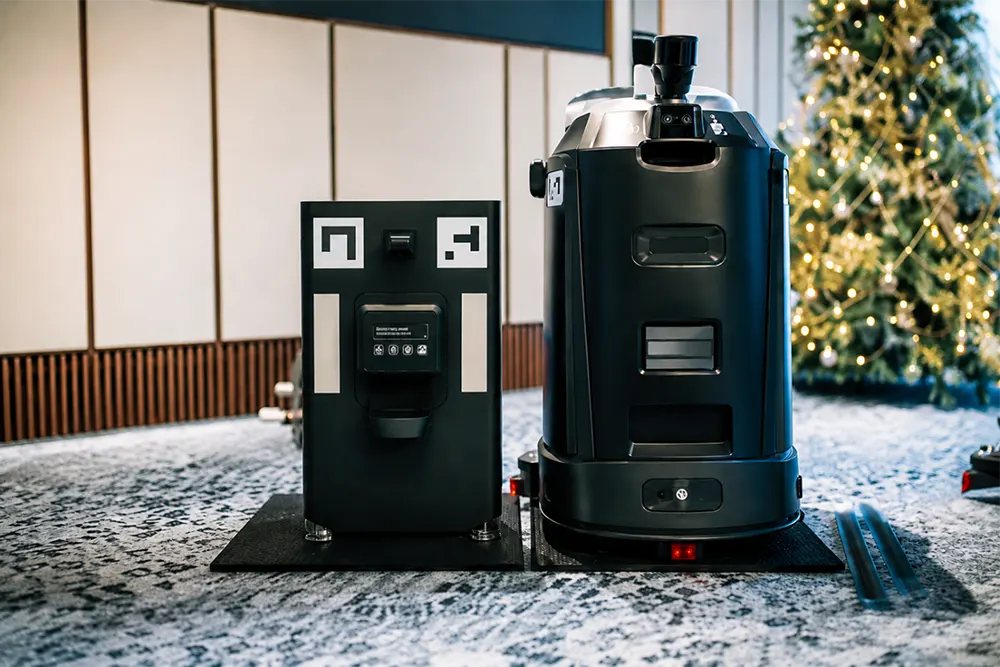
In systems equipped with the CCS-02 Charging Station, the robot can automatically return to the station when its battery level runs low, recharge and then resume its previous task.
The CWS-01 Workstation provides an even higher level of automation by combining four processes: charging the robot, refilling clean water, draining wastewater and refilling detergent. This matters in a large facility because it automates not only the cleaning process but also some of the activities between two operating cycles.
Why are more large facilities using cleaning robots?- FAQ
How can large facilities track completed cleaning more effectively?
Autonomous robots allow facility managers to track completed cleaning more accurately across large areas without relying solely on visual inspections. Data on completed tasks and processed zones makes it easier to monitor the process, while the SP50 uses CRC (Cleaning Result Checkup) to verify the results and reclean a specific zone when necessary.
Why does floor safety provide an important reason to automate cleaning?
In large facilities, wet and dirty floors increase the risk of slips, falls and injuries. Scrubber-dryer robots wash the floor and immediately collect wastewater with a squeegee and vacuum system, leaving the surface considerably drier and safer for employees and visitors.
Introducing cleaning robots makes the most sense when their role corresponds to the floor area, layout, type of dirt and existing maintenance organisation. If you are assessing whether automation makes sense for your facility, we can review the operating conditions together and select the appropriate solution.
About the author:
Milja Tonić – SEO Content Strategist & Copywriter
Milja Tonić is an SEO Content Strategist and Copywriter who specialises in creating expert content on facility management, professional maintenance of commercial facilities and cleaning process automation.
Through research, SEO strategy and original content development, she creates content on professional hygiene, facility management and the use of autonomous cleaning robots in various commercial environments.

0 Comments