


How does a cleaning robot detect people and obstacles? The robot continuously monitors its surroundings using 3D LiDAR, 3D cameras, and other sensors. The system processes this data in real time and detects people, carts, boxes, pallets, furniture, and other objects that are either present or suddenly appear along its planned path.
Therefore, the robot does not rely solely on a pre-created map of the space. As it moves, its sensors continuously scan the surroundings and detect changes in the environment.
NIST states that sensor-based human detection and tracking systems can use data about people’s locations and movements to give the robot better situational awareness of its surroundings.
This capability is particularly important in commercial facilities, where a passage that was clear only moments ago can suddenly become occupied by a person, cart, or piece of equipment. Sensor-based detection and real-time data processing form part of the autonomous navigation technology used by modern commercial cleaning robots.
How does LiDAR detect obstacles in front of the robot?
LiDAR uses laser pulses to measure the distance between the robot and objects in its surroundings. A large number of these measurements provides the system with spatial data about walls, columns, shelves, and other objects. When a new obstacle appears along the route, the robot can detect its position relative to itself and the surrounding space.
Therefore, LiDAR does more than create a map. The robot also uses the same type of spatial data for autonomous navigation and obstacle detection.
For example, the CenoBots L3 uses 96-channel 3D LiDAR, while the S5 uses 32-channel 3D LiDAR. In the L3, this system works alongside AI-powered data processing to plan routes and avoid obstacles in dynamic environments.
Why does the robot use 3D cameras if it already has LiDAR?
LiDAR precisely measures distances and spatial geometry, while 3D depth cameras provide additional information about depth and objects around the robot. By combining multiple sensors, the system gains a more complete understanding of its surroundings than it would by relying on a single data source.
A person, cart, box, piece of furniture, or object close to the floor creates a different situation for the navigation system. The system therefore combines data from multiple sensors so that the robot can monitor its surroundings more reliably as it moves.
How does the robot detect people who are moving?
A moving person represents a dynamic obstacle whose position can change quickly. The sensors therefore continuously collect new spatial data, while the navigation system processes changes in real time. This allows the robot to detect a person entering its path and adjust its movement to the new situation.
Can the robot detect cables and other low-lying obstacles?
Yes, provided that the specific model has a sensor system designed to detect them. The CenoBots L3 can detect floor-level obstacles, including cables laid across the surface and temporary rugs, allowing it to avoid them and reduce the risk of entanglement or disruption to the cleaning system.
This demonstrates why detecting only large objects is not enough.
An obstacle may be as tall as a person or pallet, but it may also rise only a few centimetres above the floor. Detection capabilities therefore vary between models and should be assessed according to the specific environment in which the robot will operate.
What happens when the robot detects an obstacle?
When the robot detects an obstacle, the navigation system determines how to adjust its movement in real time. Depending on the situation, the robot can slow down, stop, change its route, or pause temporarily before continuing when conditions allow. In this way, it can adapt its planned route to changes in the environment.
This route adjustment forms part of autonomous navigation, which is why modern autonomous cleaning robots do not require floor markers.
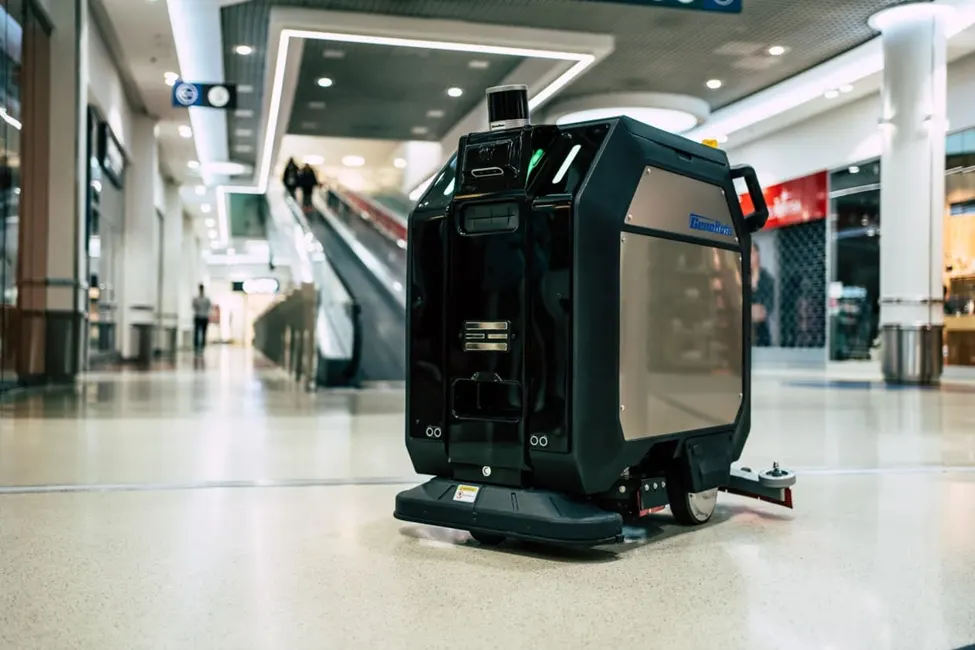
Table: Which obstacles can the robot detect?
| Obstacle | What changes in the environment | Why it matters for navigation |
| People | They constantly change position | They require a real-time response |
| Carts | They may enter or remain on the route | They temporarily block the passage |
| Boxes and pallets | They may be placed in a new location | They change the available passage width |
| Furniture and equipment | They may remain fixed or be moved | They change the available route |
| Vehicles for models that support vehicle detection | They move through certain facilities | They represent large dynamic obstacles |
| Cables and low-lying objects | They lie close to the floor | They require surface-level detection |
How does a cleaning robot detect people and obstacles? – FAQ
Does an obstacle need to appear on the map for the robot to detect it?
No. An obstacle does not need to appear on the digital map beforehand. During operation, the sensors can detect a new object along the route, such as a person, cart, box, or pallet, allowing the navigation system to respond to a change that occurred after the space was mapped.
Can the robot detect a vehicle?
Yes, if the model supports this function. The CenoBots S5 has a vehicle detection system that adjusts its movement in dynamic environments. This function is particularly important in garages, warehouses, and logistics facilities where the robot may share its working area with vehicles.
Is obstacle detection the same as dirt detection?
No. Obstacle detection supports robot navigation, while dirt detection determines where cleaning is required. The robot can therefore detect a box as an obstacle without assessing the cleanliness of the floor, while dirt detection systems analyse the surface itself to identify areas that require additional cleaning.
Choosing an autonomous robot depends on more than the size of the area it needs to clean. Passage width, equipment layout, the level of pedestrian traffic, and the types of obstacles that appear in the space each day also influence which solution makes the most sense.
If you would like to assess what would best suit your facility, we can begin the conversation by discussing your space and how you use it, without requiring you to know in advance which model or technology you need.
About the author:
Milja Tonić SEO Content Strategist & Copywriter
Milja Tonić is an SEO Content Strategist and Copywriter who specialises in creating expert content on facility management, professional maintenance of commercial facilities, and cleaning process automation.
Through research, SEO strategy, and original writing, she develops content on professional hygiene, facility management, and the use of autonomous cleaning robots in various commercial environments.

0 Comments