

Why a cleaning robot can reduce water and chemical use? A cleaning robot can reduce water and chemical use because it controls the solution flow, adjusts operating parameters and systematically cleans the designated area. Instead of relying on manual estimates, the process follows predefined parameters, allowing for more efficient and consistent use of resources.
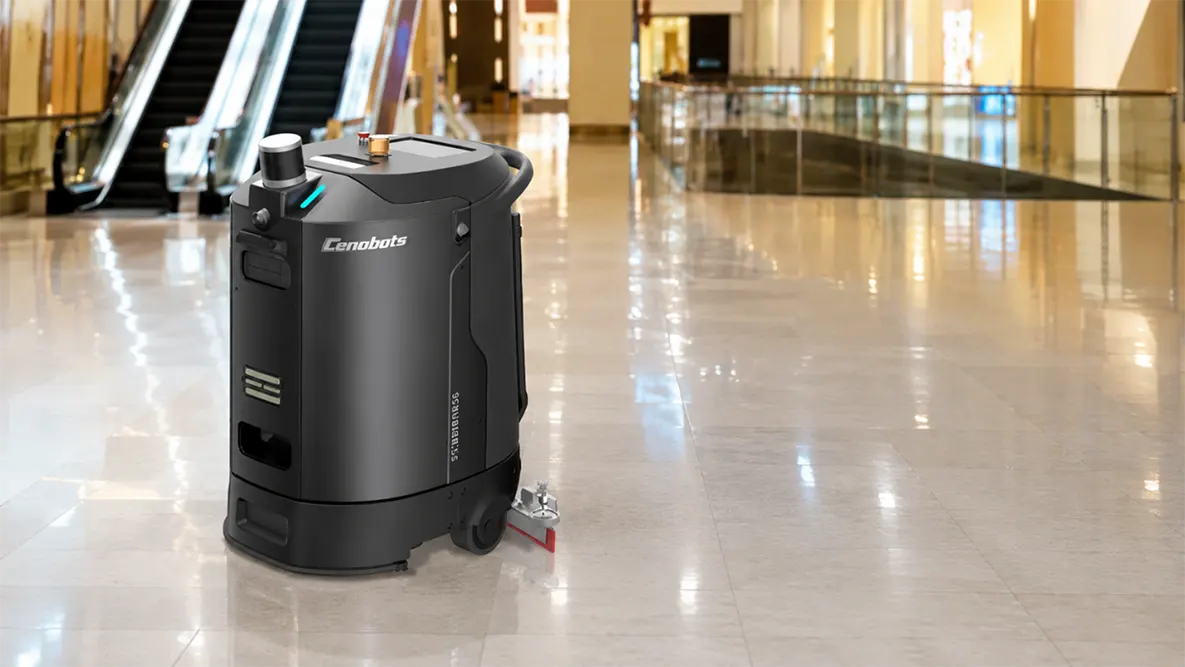
CenoBots scrubber-dryer models L3, L4 and L50, designed to wash and dry hard floors, use water and cleaning agents as part of a controlled cleaning system. This resource control represents only one aspect of how commercial cleaning robots automate the maintenance of large, high-traffic areas.
How does a robot reduce water and chemical use?
CenoBots robots reduce unnecessary consumption by dispensing the cleaning solution in a controlled manner and systematically cleaning the area. A pump and valves regulate the amount of water and detergent delivered to the brushes, while precise route planning reduces unnecessary passes and overlaps.
Controlled dispensing also plays an important role in the proper use of cleaning agents. EU-OSHA warns that excessive dosing and improper application of cleaning agents can increase chemical-related risks, which makes controlled use an important part of professional cleaning.
This is how the individual models work:
- L3 has a 25 l solution tank and uses a 96-channel 3D LiDAR for precise autonomous route planning. Its recovery tank also has a capacity of 25 l, keeping the clean and used solutions separate in equal volumes throughout the cleaning cycle.Controlled solution application and systematic movement allow for more efficient water and chemical use.
- L4 features Smart Flow, which adjusts the solution flow to the cleaning speed. CenoBots directly links this function to reducing unnecessary water and detergent consumption.
- L50 has a 55 l solution tank, autonomous route planning, and Save Water and Save Detergent functions. These functions rely on a five-stage filtration system that recycles water during operation, while automatic detergent mixing further reduces unnecessary cleaning agent consumption.
All three models therefore share the advantage of a controlled and repeatable cleaning process, while L4 also features the documented Smart Flow function, which adjusts the flow rate.
Why can route planning reduce unnecessary consumption?
Route planning reduces unnecessary movement and route overlap. When the robot avoids cleaning the same section of the floor repeatedly, it also reduces the potential for additional water, cleaning agent, energy and time consumption.
This represents an indirect saving: navigation does not dispense the solution but reduces unnecessary work.
Does the robot use the same parameters for every task?
No. Operators can adjust parameters such as water flow, brush pressure and operating mode to meet the cleaning requirements. This allows them to match the intensity of the process to the surface and task instead of treating every part of the facility in the same way.
This approach avoids unnecessarily intensive cleaning where it is not required.
What is a Workstation and which models use it?
A Workstation is an automated station that allows the robot to perform part of its routine maintenance without operator intervention. Depending on the model, it can charge the battery, replenish clean water and detergent, and drain wastewater, enabling longer autonomous cleaning cycles.
- L3 uses the WS3 Workstation, which automatically charges the robot, replenishes water and detergent, and drains wastewater. L3 can also use the WT3 Mobile Water Tank, which holds 60 l of clean water and 50 l of wastewater, when a fixed water connection is impractical.
- L4 offers an optional 4-in-1 Workstation that performs four functions: automatic battery charging, clean water replenishment, wastewater drainage and detergent replenishment.
- CenoBots L50 can connect to an automated Workstation for battery charging and water replenishment and drainage.
Does the robot always use less water than manual cleaning?
No one can claim that a robot will use less water and chemicals in every facility. Consumption depends on the surface, level of soiling, operating mode, cleaning frequency and selected parameters.
It is more accurate to say that CenoBots technology enables more controlled resource use and reduces unnecessary consumption, without stating a universal percentage saving.
Suggested table: What should you assess before configuring the robot?
| Facility condition | What to assess | Why it matters for consumption |
| Level of soiling | How dirty the floor actually is | Determines the required cleaning intensity |
| Type of dirt | Dust, shoe marks, grease or other dirt | Different types of dirt may require different approaches |
| Floor type | The material and characteristics of the floor surface | Cleaning parameters should suit the surface |
| Cleaning frequency | How often a particular area is cleaned | Not every area requires the same number of cycles |
| Foot traffic | When and how extensively people use the space | Areas with different traffic levels have different requirements |
| Area size | The area the robot covers in a single task | Affects cycle planning and the required resources |
What determines the actual water and chemical savings?
The actual savings depend on how well the robot model, route and cleaning parameters suit the specific facility, which makes choosing the right autonomous cleaning robot important even before operators define the operating mode.
You should therefore not determine the percentage saving in advance without data from the specific facility.
Why a cleaning robot can reduce water and chemical use?- FAQ
Can a CenoBots robot operate with water only, without detergent?
This depends on the requirements of the specific cleaning task and the type of dirt. An appropriate cleaning mode may be sufficient for certain surfaces and levels of soiling, while other tasks require a cleaning agent. Always follow the surface requirements and the recommendations for the cleaning agent in use.
What happens to the dirty water after the robot cleans the floor?
After cleaning, CenoBots scrubber-dryer models L3, L4 and L50 vacuum the dirty water from the floor and collect it in a separate recovery tank. The capacity of this tank depends on the model: L3 has a 25 l tank, while L4 has a 36 l tank, which determines how long the robot can operate before it requires draining. This keeps the clean water or cleaning solution and the collected wastewater in separate tanks.
Does tank size determine how economical the robot is?
No. A larger tank primarily allows the robot to clean a larger area before it requires replenishment or draining. Capacity alone does not automatically reduce water or chemical consumption, so the entire cleaning process and operating conditions determine efficiency.
Does water consumption change when the robot cleans a larger area?
The total amount of water required naturally also depends on the scale of the task, but a larger floor area alone does not indicate how efficient the cleaning will be. An accurate assessment requires an evaluation of the completed task, surface conditions and the robot’s operating settings.
The space in which the robot will operate determines how efficiently it can use water and chemicals. An analysis of the surface, level of soiling, routes and cleaning schedule reveals which CenoBots model and operating mode suit the specific facility. The assessment can begin with information about your premises, after which an appropriate solution can be defined.
About the author:
Milja Tonić – SEO Content Strategist & Copywriter
Milja Tonić is an SEO Content Strategist and Copywriter who specialises in creating expert content on facility management, professional maintenance of commercial facilities and cleaning process automation.
Through research, SEO strategy and original content development, she creates content about professional hygiene, facility management and the use of autonomous cleaning robots in various commercial environments.

0 Comments