

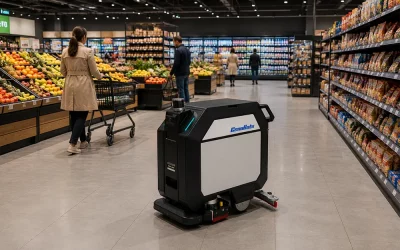
Why can’t a cleaning robot completely replace a human worker? A cleaning robot cannot completely replace a human worker because it primarily automates repetitive floor-cleaning tasks, while many maintenance tasks require human judgement, access to hard-to-reach areas and work on different surfaces. Its role is therefore to take over part of the work, not the complete maintenance of the facility.
In professional maintenance, the most important question is not whether a commercial cleaning robot can work independently, but which tasks should be automated and which should remain the responsibility of employees.
Which tasks can a robot take over from employees?
A robot can take over repetitive floor-maintenance tasks, such as:
- washing and drying hard floors
- sweeping and collecting dry debris
- vacuuming hard and soft floors and carpets
depending on the model and type of surface.
It proves particularly useful when the same areas require regular cleaning because it can complete predefined tasks autonomously, without requiring an employee to operate the machine continuously.
This changes how managers allocate work within the facility.
Instead of spending a significant part of a shift pushing a floor-cleaning machine or repeatedly following the same route through a corridor, retail area or warehouse, an employee can assign that part of the work to the robot.
CenoBots robots also perform different roles:
- L3, L4 and L50 wash and dry hard floors
- S5 sweeps and collects dry debris
- SP50 can vacuum autonomously and perform targeted cleaning of detected dirt
However, this does not mean that automation covers everything included in professional cleaning.
Which tasks still require a human worker?
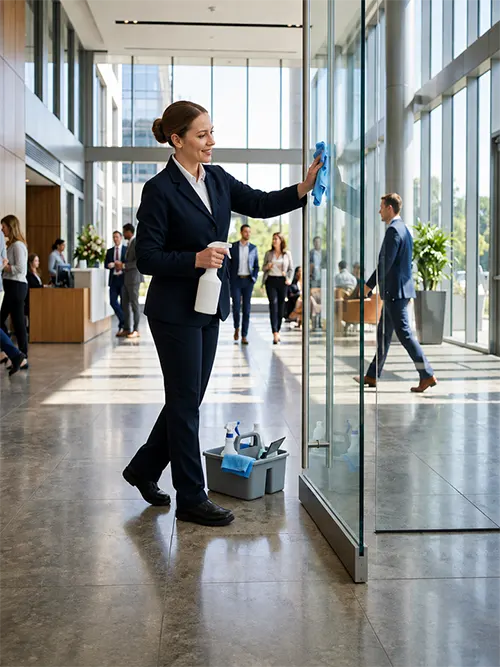
A human worker remains necessary for tasks that fall outside the robot’s defined function:
- precise cleaning of corners and hard-to-reach areas
- cleaning vertical and high-touch surfaces
- disinfection
- deep cleaning of furniture
- responding to situations that require judgement
The robot therefore handles a specific part of the process, while employees address its practical limitations.
A good example is a commercial facility where a robot independently washes hundreds or thousands of square metres of flooring. This does not mean that it has cleaned the entire facility.
The following areas may still require cleaning:
- tables, shelves and other horizontal surfaces
- doors, handles and other frequently touched surfaces
- toilets
- vertical surfaces
- narrow corners and areas that the robot cannot physically access
- specific types of dirt that require a different procedure
Why is autonomous navigation different from fully autonomous cleaning?
Autonomous navigation means that a robot can independently complete the task for which it was designed: move through a mapped space, follow a planned route and respond to obstacles. It does not mean that the robot can identify and complete every maintenance task that arises in the facility during a shift.
This distinction is important.
A floor-washing and drying robot can operate with a high degree of autonomy within that specific process, but its task still has clear physical limits.
These limits also form part of a broader regulatory framework: in Serbia, the Ministry of Economy’s Machinery Safety Regulation, which aligns with the European Machinery Directive, applies to commercial cleaning robots as it does to any other machine.
Why do detailed cleaning and disinfection remain important employee responsibilities?
Detailed cleaning requires access to surfaces and areas outside the standard route of a floor-cleaning robot, while disinfection may require a precisely defined procedure for specific high-touch surfaces. A robot can therefore relieve staff of routine floor maintenance, but it does not automatically take over the facility’s complete hygiene protocol.
Does the robot work without supervision or simply without an operator?
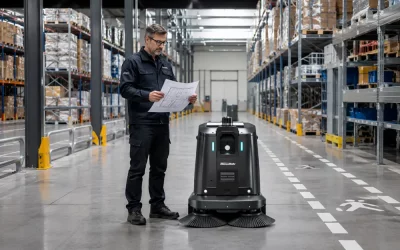
A cleaning robot does not work without supervision; it works without requiring an employee to physically operate the machine during cleaning. This represents the difference between completing a task autonomously and removing every human role from the process.
In practice, the robot’s operation still requires a third role, alongside the robot and the staff who clean the areas it cannot cover: a supervisor, who monitors routes, checks results and responds to exceptions.
This role involves:
- monitoring whether the robot has completed its tasks and achieved satisfactory coverage
- resolving situations when the robot encounters an obstacle or an area it cannot clean
- redirecting the time saved through automation towards tasks that genuinely require human involvement
In other words, the robot does not eliminate the need to organise work; it shifts the focus from physical execution to supervision and process management.
Why is cleaning at night or outside working hours an advantage that robots provide?
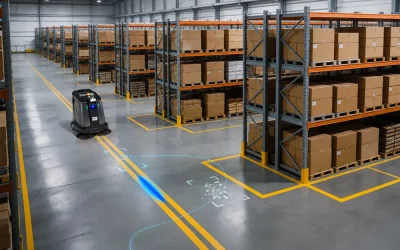
A cleaning robot can also work outside operating hours: at night, early in the morning or when the facility is not in use. In this way, it takes over part of the work that would otherwise require employees to work outside their usual shifts.
This is particularly valuable in facilities that operate for long hours or continuously, such as supermarkets, warehouses and commercial premises with extended operating hours, where manual cleaning outside a regular shift would require additional shifts, overtime or extra staff.
The robot uses this advantage in two ways:
- it cleans the main floor areas while the facility is closed, without disturbing customers, guests or employees
- it allows employees to arrive at an already cleaned space and focus on tasks that require their presence during operating hours, such as detailed cleaning, disinfection and cleaning high-touch surfaces
What does an effective division of work between robots and employees look like?
| The robot autonomously cleans / performs | CenoBots models | Staff clean / perform |
| Washing and drying hard floors | L3, L4, L50 | Precise manual floor cleaning in inaccessible areas |
| Sweeping and collecting dry debris | S5 | Removing debris from areas that the robot cannot access |
| Vacuuming hard and soft floors and carpets | SP50 | Manually vacuuming hard-to-reach and extremely narrow areas |
| Targeted cleaning of detected dirt | SP50 | Assessing and removing dirt that requires a specialised procedure |
| Autonomous, repeated cleaning of defined floor areas according to a schedule | L3, L4, L50, S5, SP50 | Cleaning tables, shelves, furniture and other above-floor surfaces |
| Working outside operating hours without continuous machine operation | L3, L4, L50, S5, SP50 | Cleaning toilets, door handles and other high-touch surfaces |
| Moving through a mapped area and responding to obstacles | L3, L4, L50, S5, SP50 | Tasks that change during a shift and require judgement |
| Disinfecting surfaces according to the hygiene protocol |
Why can’t a cleaning robot completely replace a human worker?- FAQ
Can a robot clean an entire commercial facility?
Not when this includes every surface and every hygiene task. Commercial robots can autonomously clean the surfaces for which they were designed, primarily floors. Furniture, sanitary fixtures, high-touch and vertical surfaces, certain corners and other hard-to-reach areas may still require manual work.
For which tasks does using a robot make the most sense?
It makes the most sense to automate tasks that occur frequently, cover large floor areas and can be clearly defined. In this way, the robot takes over tasks where autonomy delivers the greatest benefit, while employees remain available to handle details and the facility’s unforeseen needs.
Does introducing a robot mean reducing the number of employees?
Not necessarily. The robot takes over part of the routine floor-cleaning work, but managers usually redirect the time it saves towards tasks that the robot cannot cover, including detailed cleaning, disinfection and system supervision. In practice, this means reallocating responsibilities within the existing team rather than automatically reducing the number of employees.
If you are considering automating maintenance, the first question should not be how many employees a robot can replace, but which part of the existing process it can reasonably take over. A brief analysis of the premises, surfaces and daily tasks can show where a robot makes sense and which model suits the specific facility.
About the author:
Milja Tonić – SEO Content Strategist & Copywriter
Milja Tonić is an SEO Content Strategist and Copywriter who specialises in creating expert content on facility management, professional maintenance of commercial facilities and the automation of cleaning processes.
Through research, SEO strategy and original writing, she develops content on professional hygiene, facility management and the use of autonomous cleaning robots in various commercial environments.

0 Comments