

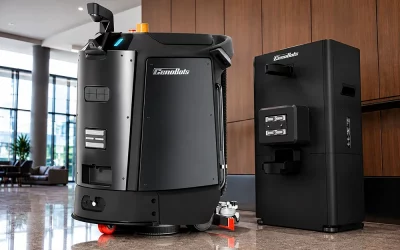
Professional cleaning robot maintenance is easiest to manage through a clear and consistent maintenance schedule. Regular daily checks to ensure the sensors are wiped clean and the filters are replaced are all it takes. These tasks take staff only a few minutes each day while ensuring the autonomous machine operates smoothly and correctly, handling everything else on its own.
There are no major surprises during regular annual or monthly inspections, and potential failures are prevented before they occur. To learn more about how human and robotic work complement each other, read the article where robotic cleaning performs better and where human work remains essential.
What does daily robot maintenance include?
At the end of each shift, only a few minutes are needed: a visual inspection of the machine for damage or loose parts and wiping dust from the sensors. If the robot is connected to the WS3 station, battery charging takes place automatically as soon as the robot returns to the dock.
When the station is directly connected to the building’s water supply and drainage system, refilling clean water, emptying dirty water, and replenishing the cleaning solution also happen automatically without any human intervention.
If the facility does not have access to a water supply where the station is located, the optional WT3 mobile tank is used. It has a capacity of 60 liters of clean water and 50 liters of wastewater. It should be checked periodically and refilled or emptied once those capacities are reached.
Without any station, the user empties the robot’s tank manually. On the CenoBots L3 model, water drains by gravity. This means simply opening a valve instead of spending more time handling the equipment.
What checks are performed on a weekly basis?
The weekly inspection goes one step beyond the daily routine. It focuses on verifying the robot’s performance and making full use of all its features, not just keeping the machine clean. It includes checking the condition of the brushes, the pressure they apply, a quick visual inspection of the filters, and confirming that the machine still follows the same route at the same speed as during the previous week.
If you notice slower operation or a change in cleaning quality, it signals that something requires closer inspection before it develops into a larger issue. During operation, the commercial cleaning robot monitors its own cleaning performance.
What does the monthly inspection look like?
The monthly inspection includes:
- more thorough sensor cleaning
- cleaning or replacing the filters
- verifying that the facility map remains accurate
- confirming that the robot still detects obstacles precisely
The condition of all cable connections and connectors is also checked because loose connections are easier to identify during a detailed inspection than during the rush of a daily routine.
This is also the time to check for software updates if the manufacturer has released a new version in the meantime.
What is done during quarterly servicing?
Every 3–4 months, servicing is more detailed than the previous inspections and usually requires a little more time per visit. All external screws and fasteners are tightened. The inside of the mechanical assembly is thoroughly cleaned of accumulated dust and debris. Safety components such as the emergency stop button are also inspected.
This is also the period when the wheels and moving parts are checked. Signs of wear that are not visible during quicker daily or weekly inspections become easier to detect.
How detailed is the annual inspection?
The annual inspection is the most comprehensive and is typically performed by a technician rather than internal staff. It includes:
- calibrating the sensors and navigation system
- checking the internal wiring and battery safety
- analyzing performance throughout the entire previous year, not just the machine’s current condition.
The inspection determines whether the robot has slowed down and consumes more energy than before. It also evaluates how often minor faults occurred compared to the previous period. This insight helps plan the replacement of components with a limited service life before they actually fail. All of this helps prevent breakdowns in the middle of a cleaning route and delays in scheduled maintenance, which can seriously disrupt the client’s operations.
This is also an excellent opportunity to verify whether you selected the right type of autonomous cleaning robot.
Does the robot maintenance schedule change depending on the type of facility?
Yes, depending on the requirements. Facilities with high levels of dust, frequent forklift traffic, or residues of packaging materials and oil, such as warehouse areas in manufacturing plants, require more frequent cleaning. In such environments, wiping the sensors and checking the robot’s filters ensure reliable operation. These demanding conditions place much greater strain on the lasers, brushes, and wheels. They wear out faster than they would in typical offices or retail stores.
That is why shortening the planned maintenance intervals makes perfect sense. For example, performing weekly inspections every five days instead of every seven, or adding an extra sensor inspection in the middle of the month. Adjusting the maintenance schedule to actual operating conditions makes the difference between preventive maintenance that truly works and one that exists only on paper.
Professional cleaning robot maintenance, a quick overview
Professional cleaning robot maintenance comes down to a simple principle:
- quick routine checks every day and every week
- more thorough inspections every month and quarter
- a comprehensive analysis once a year
| Interval | Activities |
| Daily | Visual inspection for damage, sensor cleaning, station check (charging, water, cleaning solution) |
| Weekly | Brush condition and pressure, visual filter inspection, verification of route speed and coverage |
| Monthly | Sensor cleaning, filter cleaning or replacement, inspection of cables and connectors, software updates |
| Quarterly | Tightening screws, cleaning the inside of the mechanical assembly, inspecting safety components, checking the wheels |
| Annually | Sensor calibration (performed by a technician), wiring and battery inspection, annual performance analysis |
Neglected maintenance usually leads to unexpected repairs that can cost several times more than preventive maintenance.
Invekta imports robots from its commercial cleaning robot range and can help you create a maintenance schedule tailored to your specific facility.
Professional cleaning robot maintenance – Frequently asked questions (FAQ)
Does daily maintenance have to be performed by trained personnel?
Not necessarily. The daily tasks are straightforward and can be carried out by employees who have completed the basic training provided during robot implementation. A visual inspection and emptying the tank do not require technical knowledge. They simply require consistency. More complex tasks, such as calibration or component replacement, remain the responsibility of a trained technician.
What happens if one monthly inspection is skipped?
Missing a single inspection rarely causes a serious problem by itself. However, it increases the risk that a minor issue will remain unnoticed until the next quarterly inspection. Consistency is what makes the maintenance schedule effective. Occasionally skipping an inspection is not a disaster, but losing the routine over time reduces the value of the entire maintenance system.
Are software updates installed automatically, or does someone need to start them?
It depends on the robot model and its configuration. Some systems download updates automatically when connected to the internet. Others require manual installation during the monthly inspection. It is worth checking with the supplier to understand how your specific model handles software updates so that you do not miss an important upgrade.
Which is more cost-effective: handling maintenance in-house or through a service contract?
It depends on how many robots the company has and whether it already employs technical staff capable of carrying out more advanced inspections. For one or two robots, a service contract usually makes sense because it covers both technical expertise and spare parts. For a larger fleet, having an in-house trained technician may prove more cost-effective in the long run.
Contact Invekta to create a maintenance schedule tailored to your facility.
About the author:
Jasna Drenovac – Copywriter and SEO Content Strategist – Content Creation Specialist. With a focus on facility management and professional cleaning services, Jasna develops blogs, pillar content, and SEO content.
Her work is based on a combination of many years of writing and editing experience and modern SEO standards.
The expert articles published on this blog are the result of research, analytical evaluation, and editorial expertise.


0 Comments